



Taking notes and truly learning from them can be a struggle for many. Often, we find ourselves overwhelmed by information, unsure of how to organize our thoughts or retain what we’ve learned. Traditional note-taking methods, like writing long paragraphs or summarizing entire chapters, can leave us with disjointed ideas that are hard to connect later. Worse yet, we forget key points or lose track of how one idea relates to another. If this sounds familiar, you're not alone. Luckily, the Zettelkasten method offers a solution—a way to capture, organize, and link ideas that mirrors how our brain naturally works. This approach transforms note-taking from a frustrating task into a powerful tool for long-term learning and creativity.
The Zettelkasten Method
Unlike other note-taking methods, the Zettelkasten system focuses on capturing brief ideas on small index cards, recording only one idea per note, and connecting each idea with others, either directly or indirectly through their content.
If we usually take notes while reading a book and write them down on a page, with the Zettelkasten method, we would break down the key points of the reading into separate ideas, with each idea written on a single note.
This method is considered a ‘second memory’—a ‘second brain’—because it is not organized hierarchically or categorically. Instead, each idea is linked to another, much like how our brain works.
Origin of the Zettelkasten Method
Zettelkasten is a German word that translates to ‘box of notes’ or ‘file box.’
Although it has origins dating back to the 16th century, this system wasn't perfected until the 20th century, when it became well-known thanks to German sociologist and philosopher Niklas Luhmann.
Luhmann referred to this method as his ‘second memory’, using it as a tool to be more productive in learning, reflecting, and reasoning. In fact, Luhmann wrote 90,000 interlinked notes, averaging six notes a day.
Through the Zettelkasten method, Luhmann was able to publish 70 books and 400 papers.
How Luhmann Used the Zettelkasten Method
Since personal computers didn't exist during Luhmann's career, he took notes physically using index cards.
Once he had written down an idea per note, these were stored in wooden boxes for future reference.
To identify his notes, Luhmann assigned a sequential identification number, starting with 1, located in the top left corner.
If he added branches to these, he would create a new note and assign it an ID: the number of the card from which the branch emerged, accompanied by letters or numbers. For example: 1a, 1b, 1/1, 1/2, etc.
Luhmann had two different filing systems:
Bibliographic or Literature: This contained small notes about the content of texts read and the bibliographic sources of each.
Main: This contained ideas that arose based on the content read.
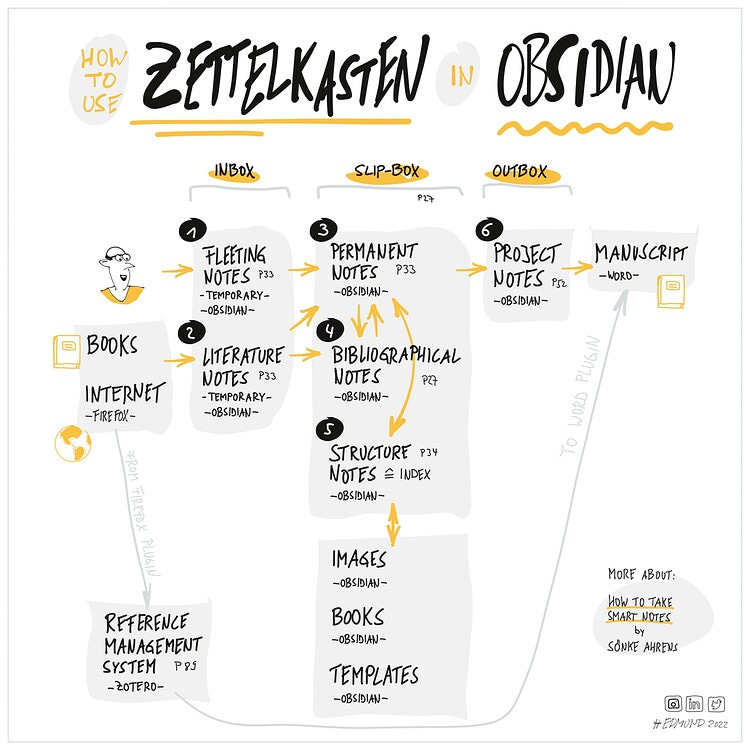
Fortunately, today we can create our own ‘second brain’ using applications like Obsidian or Roam Research to make the Zettelkasten method easier without having to add ID codes to the notes.
The Keys to the Zettelkasten Method
The core of the Zettelkasten method revolves around two fundamental ideas:
Modular Notes: When reading a book, you take notes of what you are learning. The idea of taking modular notes is that you break down these notes into individual slips of paper. Each idea that comes from those notes (each quote, story, example, etc.) should be filed individually.
Linking Notes: Forget about "filing" notes hierarchically or categorically, as is traditionally done. Organizing notes in this way is a hindrance because many times ideas can relate to each other and do not fall exclusively into one category.
Remember, our brain doesn’t work like that; it links ideas together without paying attention to any kind of hierarchy.
And that’s the Zettelkasten method: like a second brain, trying to replicate how our brain functions.
Types of Notes in the Zettelkasten Method
Quick Notes: These are created on the spot without precision, capturing as much information or key ideas as possible without worrying at that moment about how they will be linked. These are temporary notes that will later disappear from the system. Once processed into permanent notes, they are deleted.
Bibliographic or Literature Notes: Luhmann wrote bibliographic notes on the back of his literature notes. Literature notes explain in our own words the ideas from the textual quotes of external sources that we’ve written in the bibliographic notes.
Permanent Notes: These reflect our mental models (how we think, how we believe the world works). These are the most important notes in the Zettelkasten system.
Keyword Notes: These are notes with keywords that redirect us to entry points in the Zettelkasten system.
MOC or Structural Notes: These give a global context view of other permanent notes. They are the glue that links them together within a specific context.
Zettelkasten with Obsidian
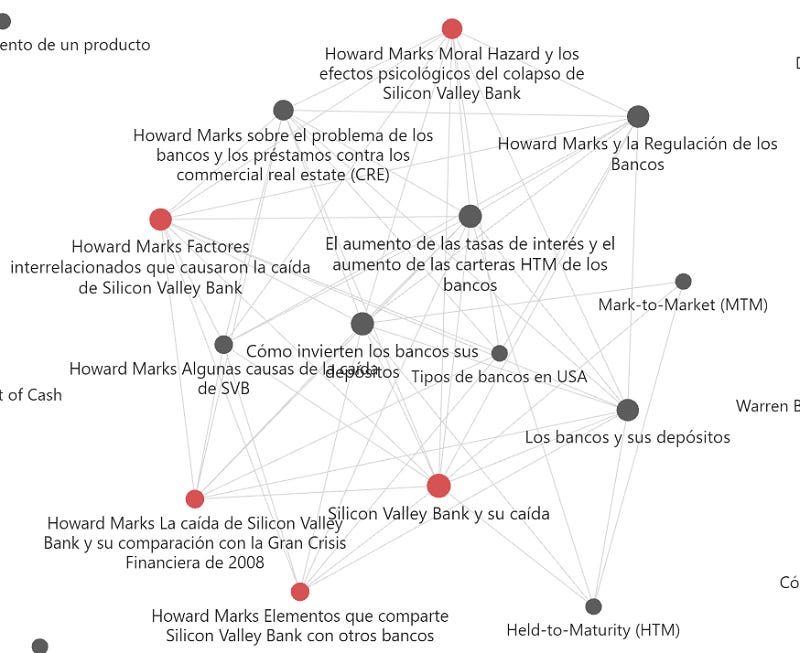
Personally, it's more difficult to enter one idea per note because my ‘second brain’ would be filled with thousands of notes, and it would be harder for me to link them together. So, I prefer to summarize my readings in one note. I link them with other related notes in my second brain. For example, last year when I published my analysis of the Silicon Valley Bank collapse, all the notes I took on the topic were interconnected:
Each note I take has the following structure:
Main Ideas
Source: Including the title of the post/book/paper…; link; author, and publication date (i.e. 'Lessons from Silicon Valley Bank. Howard Marks’ Memo published on April 17, 2023’).
Related to: In this section, I link notes/ideas from my second brain that are related to the topic.
I'm not an expert in Obsidian for note-taking, but this system works well for me. Either way, I recommend the following links if you want to use Obsidian for your notes:
How to Use Obsidian as a Zettelkasten: The Ultimate Tutorial
Conclusion
Write one idea per note.
Each note must be linked to others. The links prevent us from overlooking information that may be useful later. Here, you should briefly explain why you linked.
Each note should be written in your own words.
Avoid creating hierarchies or categories for notes.
Add the bibliographic source of each idea.
Over time, notes begin to group by theme. When this happens, create a note to group them and show their connections.
I’d love to hear from you! What note-taking method do you use? Do you prefer traditional methods, or are you ready to give Zettelkasten a try? Let me know in the comments, and feel free to share any tips or tools that have helped you along the way.
Also, if you enjoyed this post, please share it and my newsletter with your friends and colleagues!
I'm gonna have to get lots of 3x5s cuz I usually have 2 or 3 or 7 or 10 ideas on each card! I like the documentation & organization needed to make them make sense retrospectively. Now to remember to do it and get a collection boxes. Next...
Ive heard about the benefits of taking good notes in obsidian before. I should start looking into this especially since i read more and my brain is getting older. Thank you for the wonderdul instruction.