


Robert Vinall held WIX 0.00%↑ for seven years. Then, in his H1 2026 letter, he walked through exactly why he sold — line by line, assumption by assumption. Most post-mortems stop at “the thesis didn’t work out.” Vinall’s doesn’t. So I pulled every filing from the period and checked his math myself.
Wix is the company that lets your barber, or your dog walker, build a real website without touching a line of code. Pick a template, drag some blocks, publish. That’s been the pitch since 2006.
It’s not the whole pitch anymore. Somewhere in the last seven years, “build a website” became “run your business from one screen” — payments, bookings, a domain, an app store. Whether that shift actually protected Wix is most of what this post is about.
But before we get to the breakdown, a word from today's sponsor: Ezra's Notes.
The Subscriber Slowdown
Vinall’s opening line on growth: revenue went from $757 million in 2019 to almost $2 billion in 2025 — “impressive,” in his word — but growth “lagged” his own expectations, mainly because subscriber acquisition slowed.
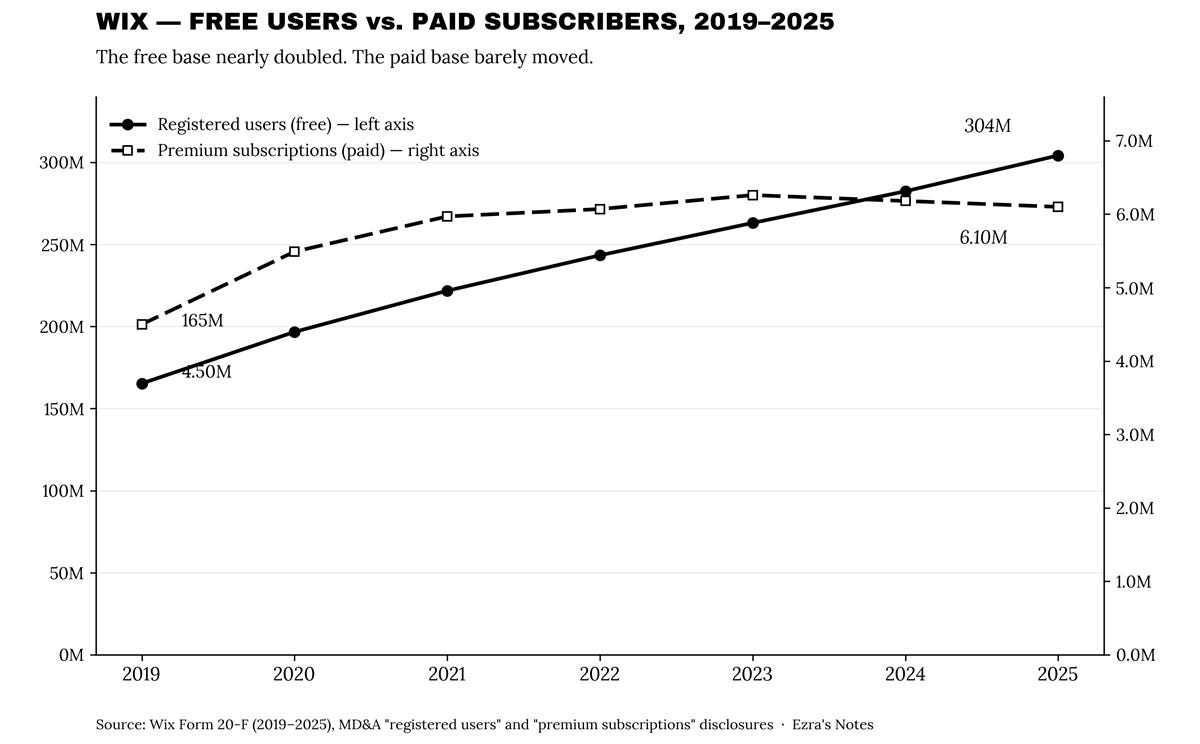
I assumed he meant premium subscriptions. So I pulled both numbers Wix reports — registered (free) users and premium (paying) subscriptions — and lined them up.
They diverge completely. Registered users grew 84% over the period. Premium subscriptions didn’t keep pace — and starting in 2023, the paying base shrank in absolute terms, not just relative to the free base.
Wix has never published a free-to-paid conversion rate. So I built one: premium subscriptions divided by registered users, year by year. It fell every single year of the seven-year period, no exceptions — from 2.72% to 2.01%, a 26% relative decline.
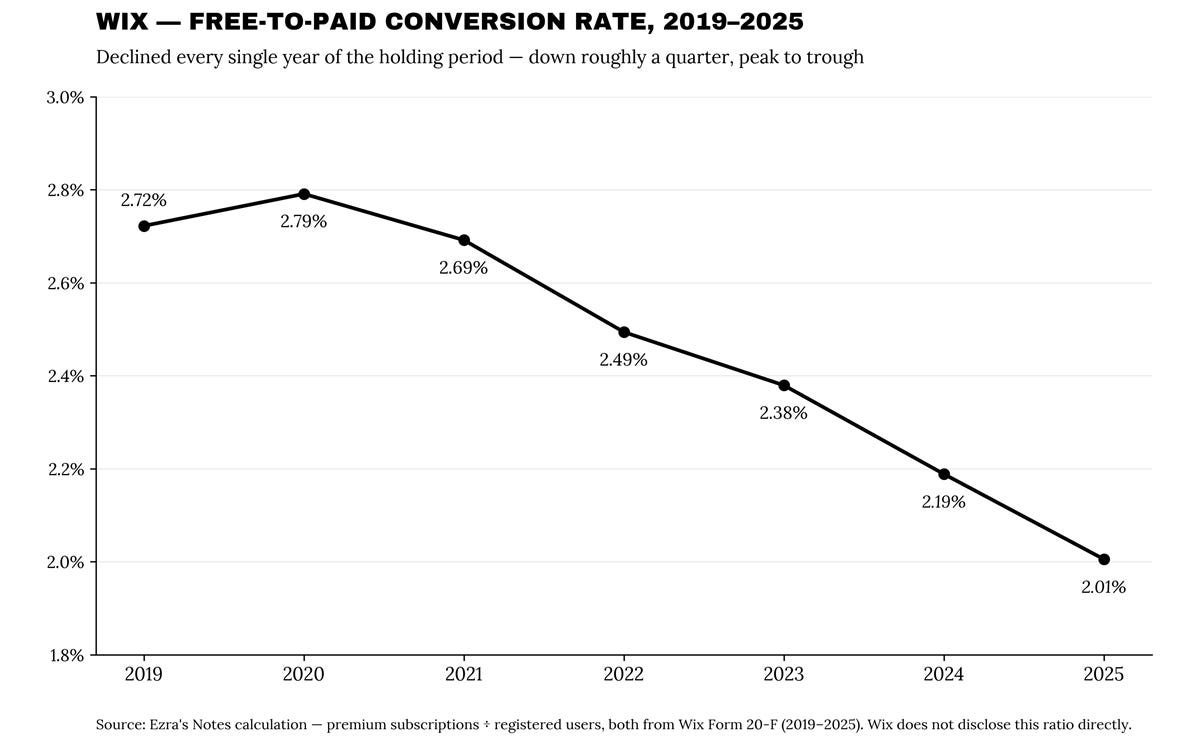
That number changes the story. Rob frames this as something that went wrong late — 2024, 2025. The filings say otherwise: the conversion engine had been leaking since the start. The last two years weren’t a break from the trend. They were the trend, finally visible in the headline subscriber count.
His original 2019 thesis had two separate growth engines packed into one sentence: “expanding website volume and higher revenue per user as clients integrated e-commerce functionality.” The data splits them cleanly. The first engine — website volume, i.e. paying subscribers — never delivered. The second did, and then some.
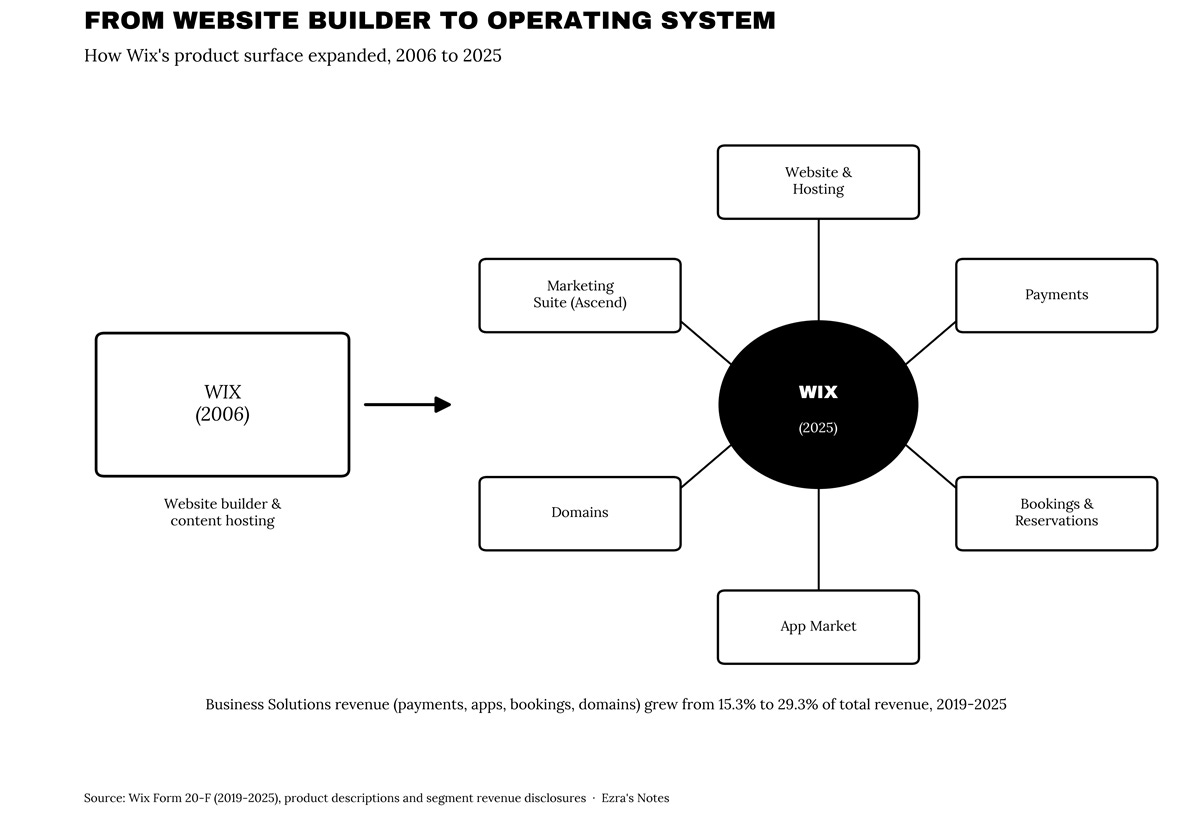
Business Solutions — Wix Payments, the app market, domains — nearly doubled its share of revenue, from 15.3% to 29.3%, over the same years conversion was falling.
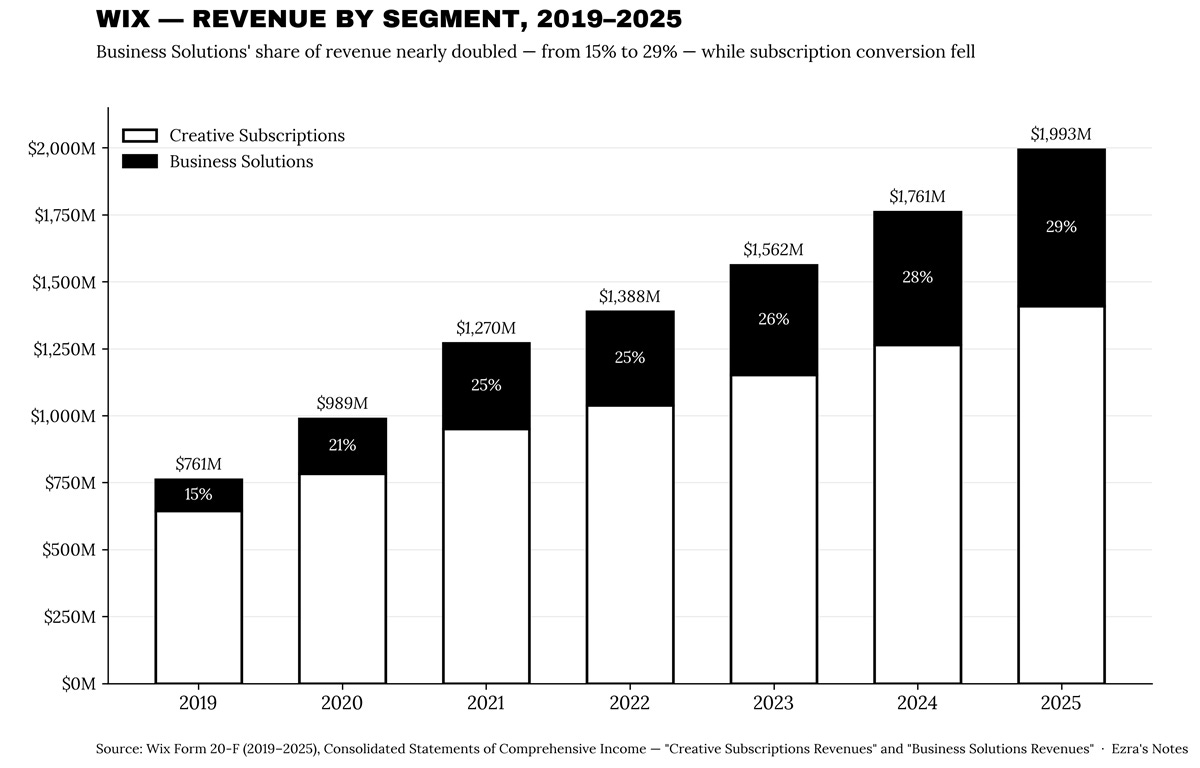
The mechanism is simple: Wix Payments takes a cut of transaction volume, and that volume comes from the whole ecosystem — including free users selling through their sites — not from premium subscription counts. The company didn’t grow the way Vinall originally underwrote. It found a second engine and let that one carry the business instead.
Free Cash Flow
The second plank of the 2019 thesis: FCF margins would expand toward 30%, driven by “natural operating leverage and declining customer acquisition costs.” Wix did report a 30% margin in 2025. Two things make that number less clean than it looks.
First, the timing. FCF margin fell every year from 2019 to 2022 — from double digits into negative territory — until activist firm Starboard Value disclosed a stake in September 2022 with one explicit ask: fix the margins and improve capital allocation. The recovery that followed tracks the activist’s entry almost exactly, not a smooth internal curve.
Second, the definition. Vinall’s own words: management’s free cash flow figure “excluded stock-based compensation” — and once you add it back, the margin isn’t 30%. It’s closer to half that.
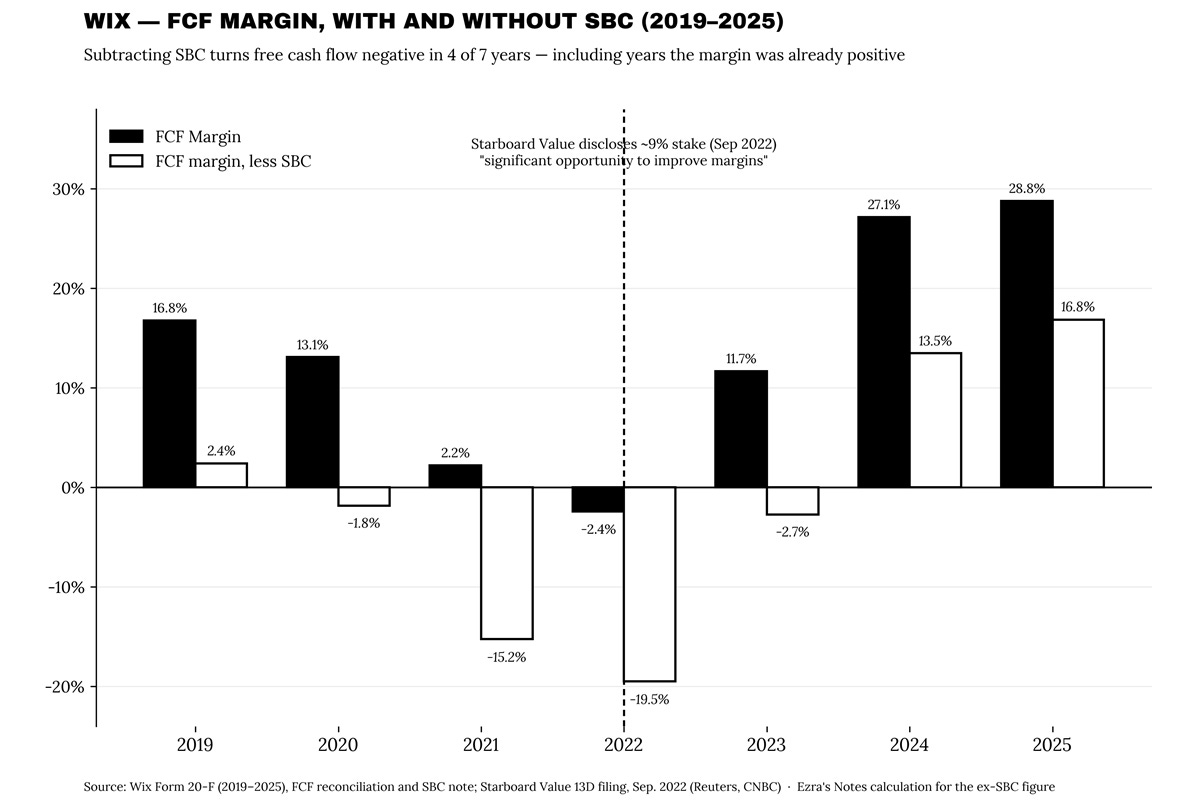
Why the gap reopened in 2025: Base44, Wix’s push into AI-assisted coding. On the Q4 2025 call, management said the quiet part out loud — they’re no longer optimizing gross margin, the thing Starboard asked for in 2022. They’re optimizing dollar profit.
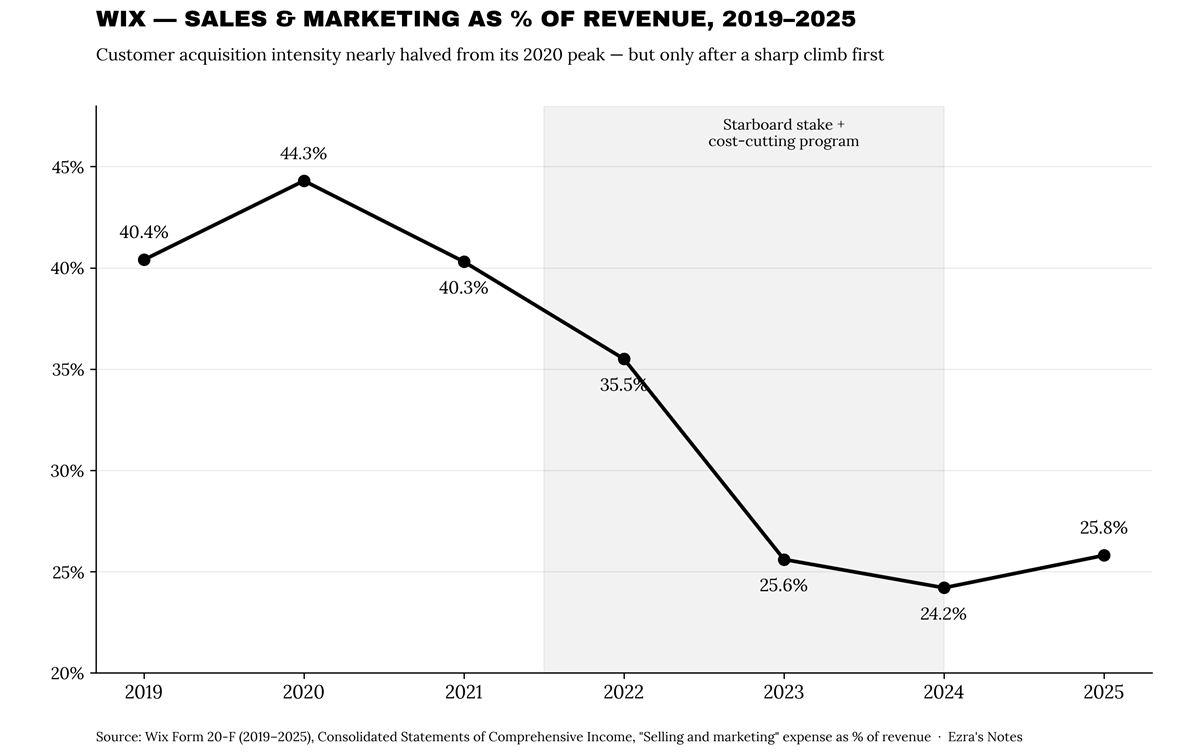
One thing did work as advertised. Customer acquisition cost, measured as sales and marketing spend over revenue, fell from 44.3% in 2020 to 24.2% in 2024 — nearly cut in half.
The Moat
Original thesis: the moat would deepen as Wix evolved “from a simple content repository into an operating system,” raising switching costs for small business customers. Vinall’s post-mortem read: it did widen — but he’s no longer certain it holds, given AI, and he’s chosen to watch from the sidelines rather than hold an opinion with money behind it.
He’s right that it widened. Wix layered payments, bookings, a domain registrar, and an app marketplace on top of the original site builder. Every product a customer adopts makes the whole stack harder to leave — payments, calendar, and website all living on one platform raises the cost of migrating any single piece.
But Wix’s own 2025’ 20-F names the threat directly, in language a company has every incentive to soften, not sharpen:
“Newly emerging technologies that utilize AI may also offer services that overlap with certain solutions we offer, including the emergence of generative AI website builders.”
Wix’s response wasn’t to defend the castle. It was to buy a stake in the army outside the walls. Base44 — the AI “vibe coding” startup the company acquired in 2025 — competes directly with Claude Code, Cursor, and Replit, the exact tools that could make Wix’s specialist software obsolete. If you can’t beat them, buy them.
Management
This is where the thesis breaks down hardest.
Rob’s original bet: a founder-led team with an owner’s mindset. His 2026 verdict: dedicated, yes — nobody left in seven years — but “growth rather than owner-oriented.” I went looking for the numbers behind that sentence.
Ownership. After nearly two decades running the company, CEO Avishai Abrahami owns 1.7% of Wix in actual shares — not options, not RSUs, shares. The full management team, combined, owns 7.2%.
Compensation. Wix’s own Compensation Policy — unchanged since November 2023 — requires at least 75% of the annual bonus to rest on measurable criteria. The policy names three: collections, revenue and pre-tax profits, and user counts. Not one mention of ROIC, or return on capital, or anything resembling long-term value creation. Vinall’s line lands exactly where the policy points: “It would have helped if they had not used a flawed free cash flow metric to track profitability.”
Capital allocation. Between 2021 and 2025, Wix spent $1.6 billion buying back its own shares. Over that same stretch, diluted shares outstanding didn’t fall — they climbed, peaking near 60 million in 2024, the same year as the second-largest buyback of the period.
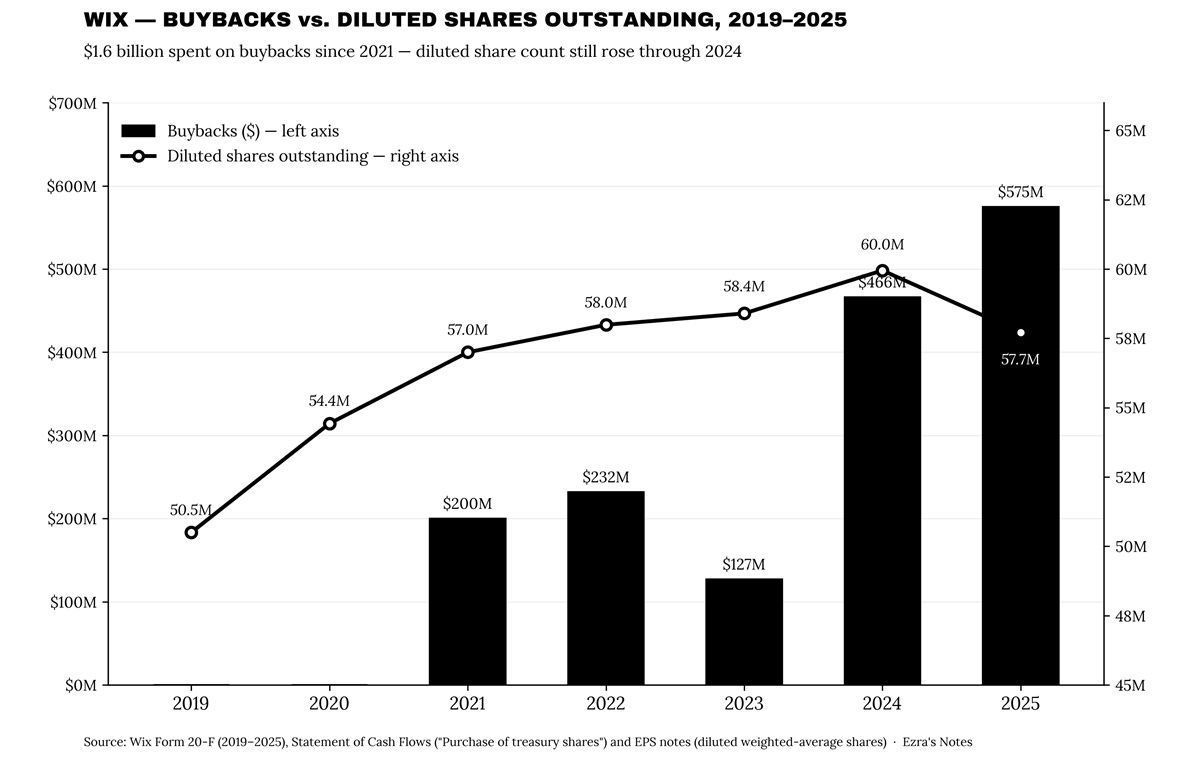
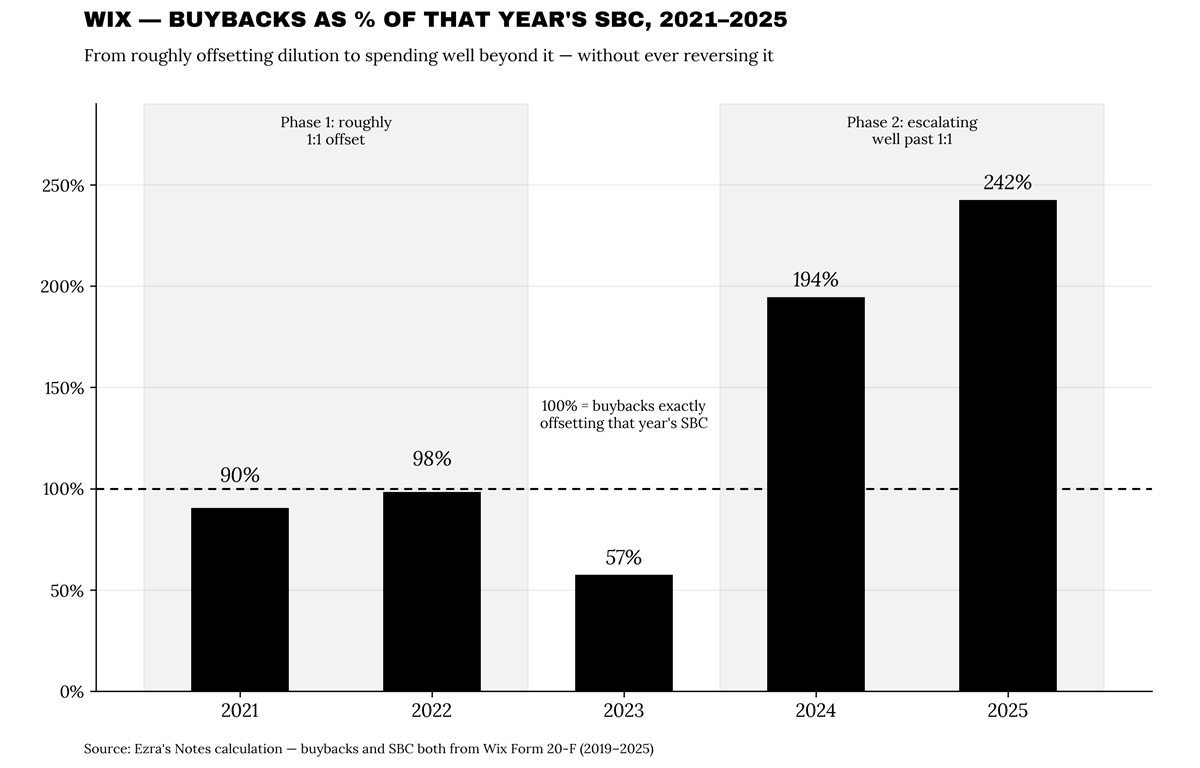
A buyback built to create value has two ingredients: cash, and a management team that believes the stock is cheap. Wix had the first. There’s no record of the second — no year in this period where a repurchase program launched with a stated view that shares were undervalued. What the numbers show instead is a repurchase sized almost exactly to that year’s stock-based compensation, quarter after quarter — not “we think this is cheap,” but “how much did we dilute this year? Buy back roughly that much.”
Final Thoughts
Wix it’s just a company that chased the next growth engine whenever the first one slowed, run by a team with almost no skin in the game, paid to hit growth-vanity-metrics targets rather than long-term value targets — sitting behind a moat that's real, moderately deep, and, by the company's own admission, under a threat it decided to acquire rather than fight.