


"Steve Jobs made a mark on this world no one will ever forget."
—Warren Buffett1
Steve Jobs once phoned Warren Buffett with one question: what should Apple AAPL 0.00%↑ do with all its cash? Buffett answered. Jobs did nothing.
I remembered that story a few days ago. I had always assumed, and I suspect many readers have too, that Jobs lacked the skills of a good capital allocator. So I went through Apple’s capital allocation during his second run at the company, from 1997 to 2011. I came away thinking that Steve, in his own way, was a good one.
Buffett told the story on CNBC’s Squawk Box in 2012.2 Jobs had called him a couple of years earlier.
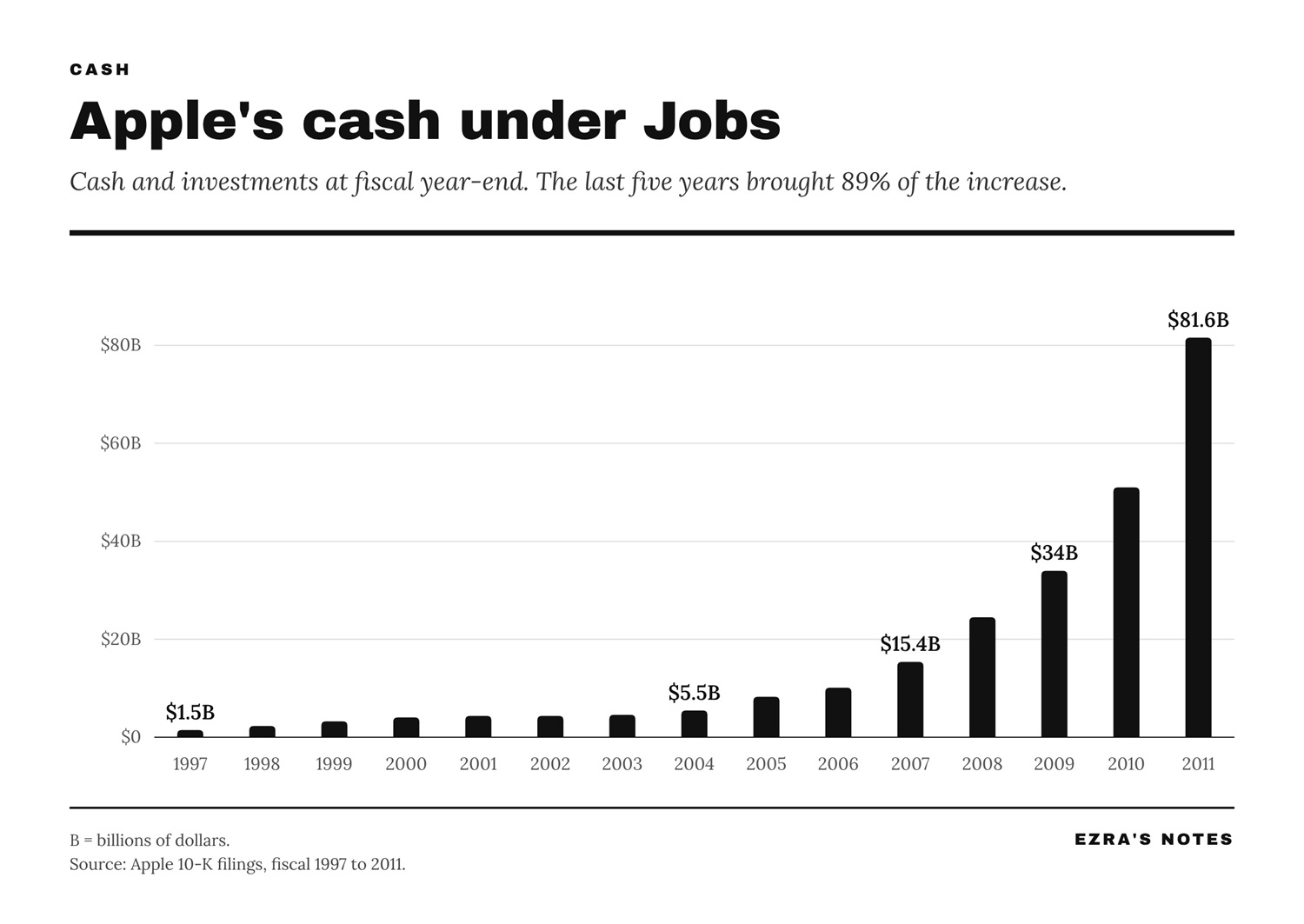
Warren laid out four choices: pay dividends, buy back shares, make acquisitions, or sit on the cash. There was a lot to sit on. In the months when the call could have happened, Apple held between $39.8 billion and $51 billion.3
To size that pile: with the $51 billion it had in September 2010, Apple could have paid cash for all of BNSF, debt included. That deal came to $44 billion, the largest acquisition in Berkshire’s history, and Warren had closed it that February.4 The $51 billion was also more than Germany spent on its military in 2010, about $45 billion.5
Buffett told him that if he thought his own stock was undervalued, he would use the cash to buy it back. Then he asked what Jobs thought of Apple’s. Steve said it was very undervalued. They talked a while longer, and Jobs did nothing. “He just liked having the cash,” Buffett said. Jobs kept his mountain of cash, much as Warren keeps one at Berkshire Hathaway.
Buffett later learned that Jobs had been telling people Warren agreed with him about doing nothing.
By Warren’s account, Apple traded at two hundred and something dollars at the time. Adjusted for the two stock splits since, that is $7 to $11 a share in today’s prices.6
Buffett gave no date. Counting back a couple of years from 2012 and matching that price, the call falls between October 21, 2009, when the stock first closed above $200, and October 13, 2010, when it crossed $300.7
Jobs had reasons to think the stock was cheap. The call came in the iPad’s year: unveiled in January 2010, on sale in April. The iPhone 4 followed in June. iPhone sales had nearly doubled in 2009 and nearly doubled again in 2010.8
I think Steve saw three things the market had not priced in:
He knew what was coming. He ran the products, so he saw them before anyone else. Apple’s earnings grew 70% in 2010 and 85% in 2011.9
Apple’s accounting hid part of its profit. Until January 2010 the company did not book an iPhone sale all at once. It spread the revenue over the device’s estimated life. Under that rule Apple earned $5.7 billion in 2009. Without it, $8.2 billion.10
His own role was one of Apple’s big risks. In January 2009 Jobs took medical leave through June. Six days later, in the middle of the financial crisis, the stock hit its low for the year: $78.20. Some of that discount may still have been in the price in 2010.11
At the end of fiscal 2010, net of cash, Apple traded at 15x that year’s earnings and 8x the next year’s.12
Steve Jobs as a capital allocator
I wanted to look at Jobs’s second run through capital allocation alone and see whether he was any good at it. When he took over as interim CEO in September 1997, Apple was closing a year with a $1.05 billion loss. It had $1.5 billion in cash and $951 million in long-term debt. The rating agencies had cut that debt to junk, and Microsoft had put in $150 million for preferred stock.13
Steve later said Apple had been 90 days from bankruptcy.14 That is where his capital allocation starts.
What Jobs did
He cleaned up the balance sheet first. In 1998 he paid off what was left of the bank loans. In 1999, $661 million of convertible notes turned into stock. In 2004 he repaid the last $300 million in cash. He issued no new debt in 14 years.15
He could have cut R&D, and didn’t. From 2001 to 2003 Apple spent $1,347 million on R&D. Over those same three years it earned $109 million in total. In its 2003 annual report Apple said that speeding up innovation was the best answer to a bad economy. Mac OS X, the iPod and the music store came out of that stretch.16
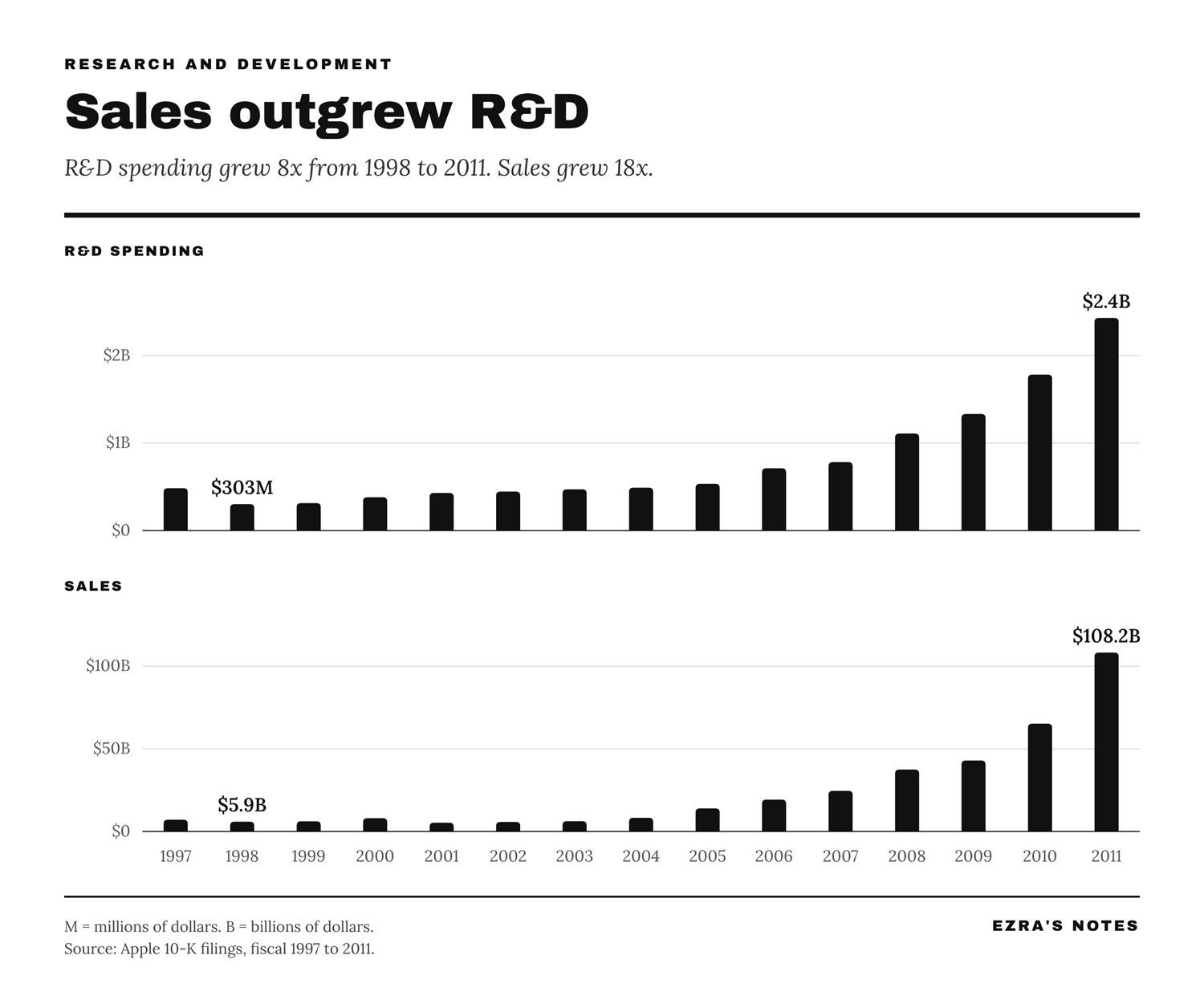
The company’s own cash paid for the Apple Stores: 65 of them between May 2001 and September 2003, for $290 million. In 2011 those stores and the ones that followed sold $14.1 billion.17
He also used the cash to lock in parts. In 2005 he prepaid $1.25 billion to five flash memory makers. In 2009 he did it again with $1 billion: $500 million to LG Display for screens and $500 million to Toshiba for flash memory.18
He bought almost no companies. In 14 years Apple paid $1.2 billion for acquisitions. They were small technology deals that ended up inside its products: Emagic (2002), maker of the Logic music software; P.A. Semi (2008) and Intrinsity (2010), both chip designers; Quattro Wireless (2010), in mobile advertising; and Siri (2010). The busiest year was 2010, with $638 million spread over several deals.19
Sales grew 18x over.
What Jobs didn’t do
From 1998 to 2011 Apple generated $90.1 billion in operating cash flow. Its cash pile grew by $80.1 billion. That is more than the whole company was worth on the stock market in 2006.20
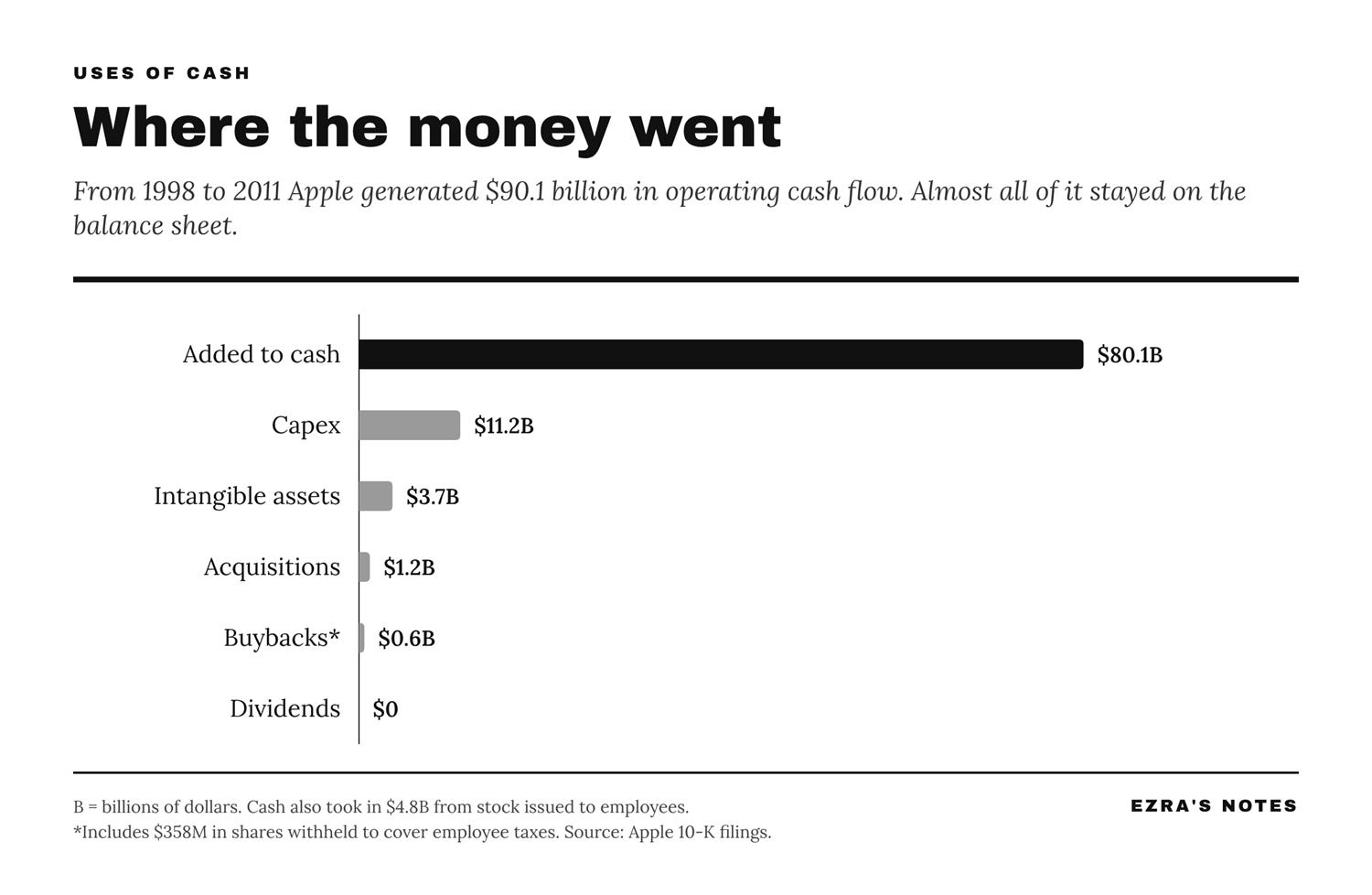
He never paid a dividend. The last one went out in fiscal 1996, before Steve came back.21
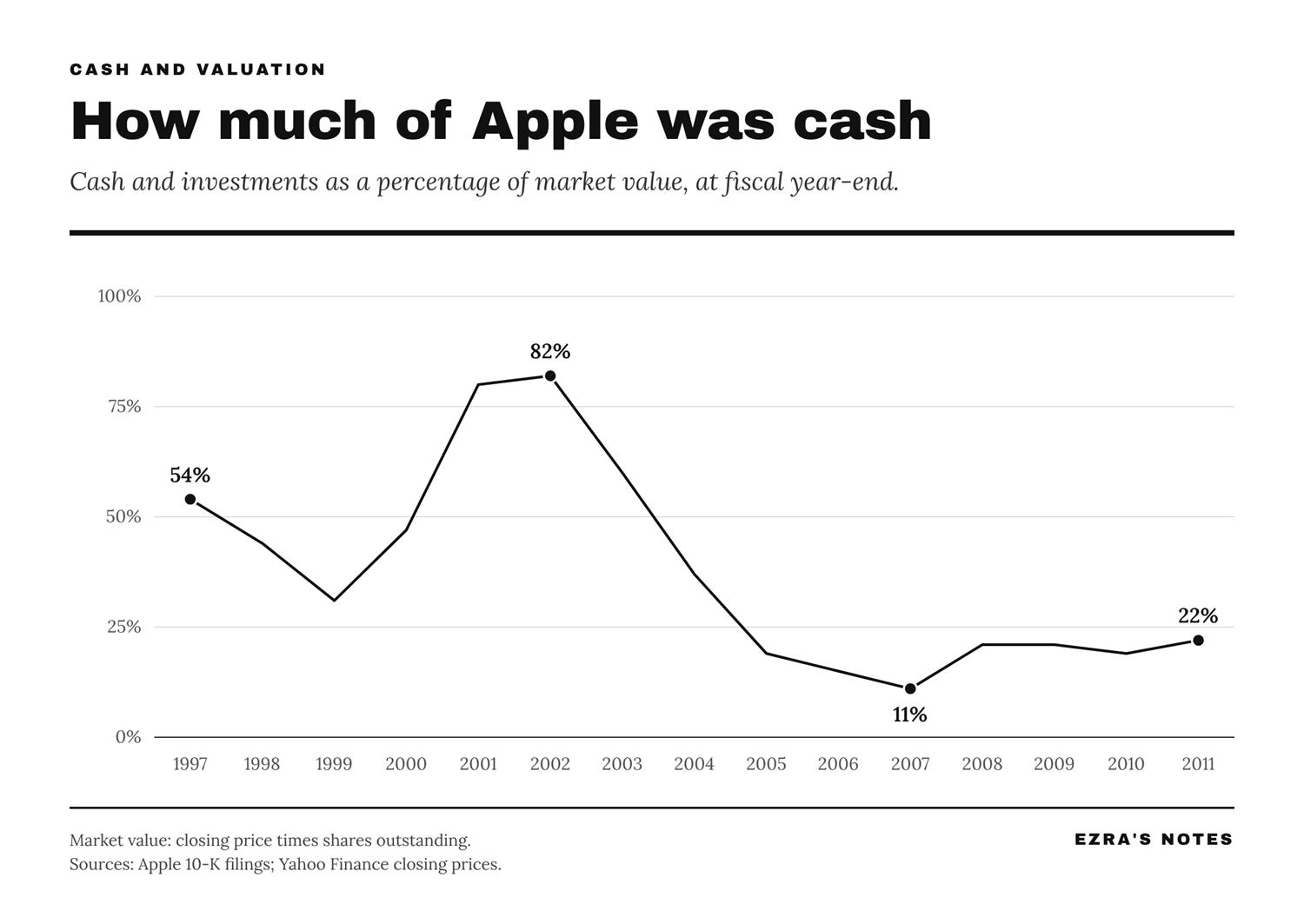
He bought back $217 million of stock in 14 years, and he did it backwards. Apple paid $15 a share in 1999 and $22.75 in 2000. In 2002 the stock closed the fiscal year at $7.36. Of every dollar a buyer paid for Apple, 82 cents was cash. That year the company bought back nothing.22
Meanwhile the share count grew 32% from 2001 to 2011, because of the stock issued under employee plans.23
And the cash earned less each year: 5.27% in 2007, 0.77% in 2011.24
When Jobs called Buffett, one dollar in five of Apple’s market value was cash.
Final thoughts
So was Steve a good capital allocator? I think so, with one weak spot.
Inside the business he allocated well. He cleaned up the balance sheet, kept R&D whole through the bad years and paid for the stores out of Apple’s own cash. The weak spot was what he did with the money left over. In 2002, with the stock at $7.36 and 82 cents of cash behind every dollar of price, a cheap buyback sat in front of him and he passed. Eight years later he told Buffett himself that the stock was very undervalued, and he passed again.
Part of that was taxes. In 2010 about 60% of the cash sat in foreign subsidiaries, and bringing it home meant a tax bill.25
He ignored Warren on buybacks. I still think Jobs was already a student of the Oracle of Omaha. Keeping cash on the balance sheet in case things go wrong is one of the lessons Buffett has taught us. Jobs followed it to the letter.
The difference is that at Berkshire the cash has two jobs, and Warren puts a size on the first one. For the bad days, Berkshire pledges to hold at least $10 billion and tends to keep at least $20 billion. Anything above that waits for a purchase: at the end of 2010 it had $38 billion, and Warren wrote that he wanted to put it to work.26 Jobs held cash only for the bad days and for the freedom to take big risks.27
In 2010 Apple had $51 billion, no debt, and $7.3 billion in operating expenses for the year.28 The cash could have covered seven years of expenses without selling a single product.
Jobs never said how much was enough.
Warren Buffett, statement to CNBC after Jobs’s death, October 6, 2011. CNBC.
Warren Buffett on CNBC’s Squawk Box, February 27, 2012, as reported by MacTrast. The account of the call, including the quote, comes from this interview.
Cash, cash equivalents and marketable securities: $39.8 billion on December 26, 2009, and $51 billion on September 25, 2010. Apple Form 10-Q for the quarter ended December 26, 2009 and Form 10-K for fiscal 2010.
The deal valued BNSF at about $44 billion, including $10 billion of debt. Berkshire Hathaway and BNSF joint press release, November 3, 2009. Closing in February 2010: The Rational Walk.
Germany’s military expenditure in 2010 was an estimated $45.2 billion. SIPRI Yearbook 2011.
My calculation: $200 and $300 divided by 28, for the 7-for-1 split of 2014 and the 4-for-1 split of 2020.
Closing prices of $204.92 on October 21, 2009, and $300.14 on October 13, 2010. Yahoo Finance.
iPhone sales of $6.7 billion in fiscal 2008, $13 billion in 2009 and $25.2 billion in 2010. Apple Form 10-K for fiscal 2010.
Net income of $8.2 billion in fiscal 2009, $14 billion in 2010 and $25.9 billion in 2011. Apple Form 10-K for fiscal 2011.
Apple Form 10-K/A for fiscal 2009, which restated 2009 net income to $8.2 billion, and the October 2009 earnings release, which reported $5.7 billion under the old rule.
Medical leave announced January 14, 2009: CNN Money. Closing low of $78.20 on January 20, 2009: Yahoo Finance. Apple listed its dependence on key personnel, its CEO included, as a risk factor in its Form 10-K for fiscal 2009.
My calculation: market value at fiscal year-end 2010 minus cash ($216.8 billion), divided by net income for fiscal 2010 and fiscal 2011. Share count and net income from Apple’s Forms 10-K; closing price from Yahoo Finance.
Net loss, cash, long-term debt, the Microsoft investment and the debt ratings (B3 and Caa2 at Moody’s, B- and CCC at Standard & Poor’s) are in Apple’s Form 10-K for fiscal 1997. The filing calls the ratings “non-investment grade.”
Steve Jobs at the D8 conference, June 2010, as reported by Fortune.
R&D of $430 million, $446 million and $471 million, and net income of -$25 million, $65 million and $69 million, in fiscal 2001, 2002 and 2003. Apple Form 10-K for fiscal 2003.
Apple had 8 stores at the end of fiscal 2001, 40 at the end of 2002 and 65 at the end of 2003, per its Form 10-K for fiscal 2003. The $290 million is retail capital spending for fiscal 2001 to 2003, from the Forms 10-K for those years. First two stores, May 19, 2001: Apple press release. Retail sales of $14.1 billion: Form 10-K for fiscal 2011.
Flash memory prepayments: Apple press release, November 21, 2005. LG Display and Toshiba prepayments: Apple Form 10-K/A for fiscal 2009.
Cash paid for acquisitions by fiscal year, from Apple’s cash flow statements: $10 million (1998), $52 million (2002), $220 million (2008), $638 million (2010) and $244 million (2011). Emagic is named in the Form 10-K for fiscal 2002. Apple’s filings do not name the deals from 2008 on; those names come from press reports compiled in Wikipedia’s list of Apple acquisitions.
My sums from the cash flow statements in Apple’s Forms 10-K for fiscal 1998 to 2011 (full list on EDGAR). Apple’s market value at the end of fiscal 2006 was $65.8 billion: closing price times shares outstanding.
Apple Form 10-K for fiscal 1997.
Buybacks under the plan approved in July 1999, from Apple’s Forms 10-K for fiscal 1999, 2000, 2003 and 2007. Prices are adjusted for the 2005 split, the same basis as the $200 in Buffett’s account. The 82 cents is cash and investments divided by market value at the end of fiscal 2002, my calculation.
Shares outstanding at fiscal year-end, adjusted for the 2005 split: 702 million in 2001 and 929 million in 2011. Apple Forms 10-K for fiscal 2001 and 2011.
Weighted average interest rate earned on cash and investments. Apple Forms 10-K for fiscal 2007 and 2011.
Foreign subsidiaries held $30.8 billion of the $51 billion. Apple Form 10-K for fiscal 2010.
Berkshire Hathaway 2010 shareholder letter. The $10 billion pledge excludes cash held at the regulated utility and railroad businesses.
Jobs at Apple’s shareholder meeting, February 25, 2010, as reported by Fortune and AppleInsider.
R&D of $1.8 billion plus selling, general and administrative expenses of $5.5 billion. Apple fiscal 2010 results.
What do you think about Steve’s capital allocation skills? Was he a good capital allocator? Drop your comments!
And if you liked this post, share the love!