


Most businesses don’t fail because they run out of ideas.
They fail because they become disordered.
Decisions pile up. Products multiply. Exceptions turn into rules. Complexity creeps in slowly, almost invisibly, until the system can no longer hold itself together. What once worked begins to require constant attention, constant adjustment, constant energy.
In physics, there is a word for this tendency: entropy. Left unattended, systems drift toward disorder. Business is no exception.
Yet some companies seem oddly resistant to this pull. They do not need to reinvent themselves every few years. They do not chase every new trend. They do not depend on precise forecasts or heroic execution. Their operations feel calm. Repetitive. Almost boring.
And because of that, they last.
These are low-entropy businesses. Not because they avoid change altogether, but because their core systems are built around forces that change very slowly—or not at all. Human rituals. Biological cycles. Structural simplicity. Fixed rules.
This essay is not about valuation, growth rates, or competitive positioning in the traditional sense. It is about structure. About why certain businesses remain ordered while others gradually unravel, even when they appear successful on the surface.
To explore this idea, we will look at three very different companies:
A funeral services provider built around an unavoidable human moment.
A materials company that operates at the pace of trees.
A retailer that wins by removing decisions rather than adding them.
They share little in common at first glance. Different industries. Different geographies. Different customers. But underneath, they are governed by the same principle: they are designed for a world that doesn’t need to change very much.
Service Corporation International (SCI) — A business built for a world that doesn’t change
The phone rings.
Not because the economy is booming.
Not because rates moved.
Not because a new technology launched.
It rings because someone just lost a parent.
That is where SCI begins. And that single fact explains almost everything about why it is a low-entropy business.
Most companies wake up every morning fighting uncertainty. Will demand hold? Will customers switch? Will a new product make them irrelevant? SCI doesn’t play that game. Its core service is triggered by an event that ignores markets, innovation cycles, and quarterly narratives. Death does not wait for better conditions.
That inevitability is the first source of order.
But inevitability alone does not create a durable business. What matters is what happens after the phone rings. And here is where the structure becomes revealing.
At the moment families walk through the door, they are not looking for novelty. They are looking for familiarity. Ritual. Reassurance. The service delivered today looks almost identical to the service delivered decades ago. Same sequence. Same steps. Same expectations. Human emotions change very little at moments like these, and SCI has built its entire operation around that constancy.
Repetition is not a weakness here. It is the system.
In most industries, repetition signals stagnation. In this one, it creates calm. Processes become muscle memory. Decisions shrink. Variation disappears. The business does not need to experiment; it needs to execute. Thousands of times. In thousands of locations. With very little improvisation.
That repetition drains entropy from the system.
There is another detail that rarely gets attention, but it matters. Part of this business is organized before it is needed. Families plan ahead. Arrangements are made in quiet rooms, years in advance, often over coffee rather than grief. From an operational perspective, this shifts time itself. Work is done today for an event that will happen tomorrow. Uncertainty gets pulled forward and neutralized.
Time, which usually destabilizes businesses, becomes an ally.
Compare that to industries obsessed with speed. Software companies sprint to outrun the next update. Media businesses chase attention that evaporates overnight. Even retailers must constantly adjust to shifting tastes. SCI faces none of that pressure. There is no technological shortcut around a funeral. No app can replace presence. No platform can compress the moment.
Change arrives slowly here. Almost politely.
This is what low entropy looks like in practice. Not growth charts or scale metrics, but a system where the number of decisions that truly matter is small—and shrinking. Where the core service fulfills a fundamental human need that remains constant across generations. Where the business survives not by anticipating the future, but by being largely indifferent to it.
There is something almost uncomfortable about that stability. In a culture that celebrates disruption, SCI feels anachronistic. Quiet. Unambitious. And that is precisely its strength.
Some businesses are designed for a world that accelerates.
Others are designed for a world that doesn’t.
Service Corporation International belongs firmly to the second category. Its advantage is not innovation, brand, or even scale. Its advantage is that the rules of its game barely move. And when the rules don’t move, order compounds.
Near the end of his life, Charlie Munger once remarked how little time he had left, not how much he had accumulated. That instinct—to see the world as finite, not scalable—is rare in business.
SCI operates as if it understands that instinct.
And in doing so, it has built something surprisingly durable: a business that wins not by changing faster, but by needing to change less.

Corticeira Amorim — A business that moves at the speed of trees
The tree is not cut.
That detail matters more than it sounds.
Every nine years, a worker peels the bark from a cork oak using a small axe. The tree stays standing. It keeps growing. It keeps absorbing carbon. And it will be harvested again. And again. For more than a century.
That single biological constraint sets the tempo for Corticeira Amorim. And it explains why this is one of the lowest-entropy businesses you will ever encounter.
In a world obsessed with speed, cork refuses to hurry.
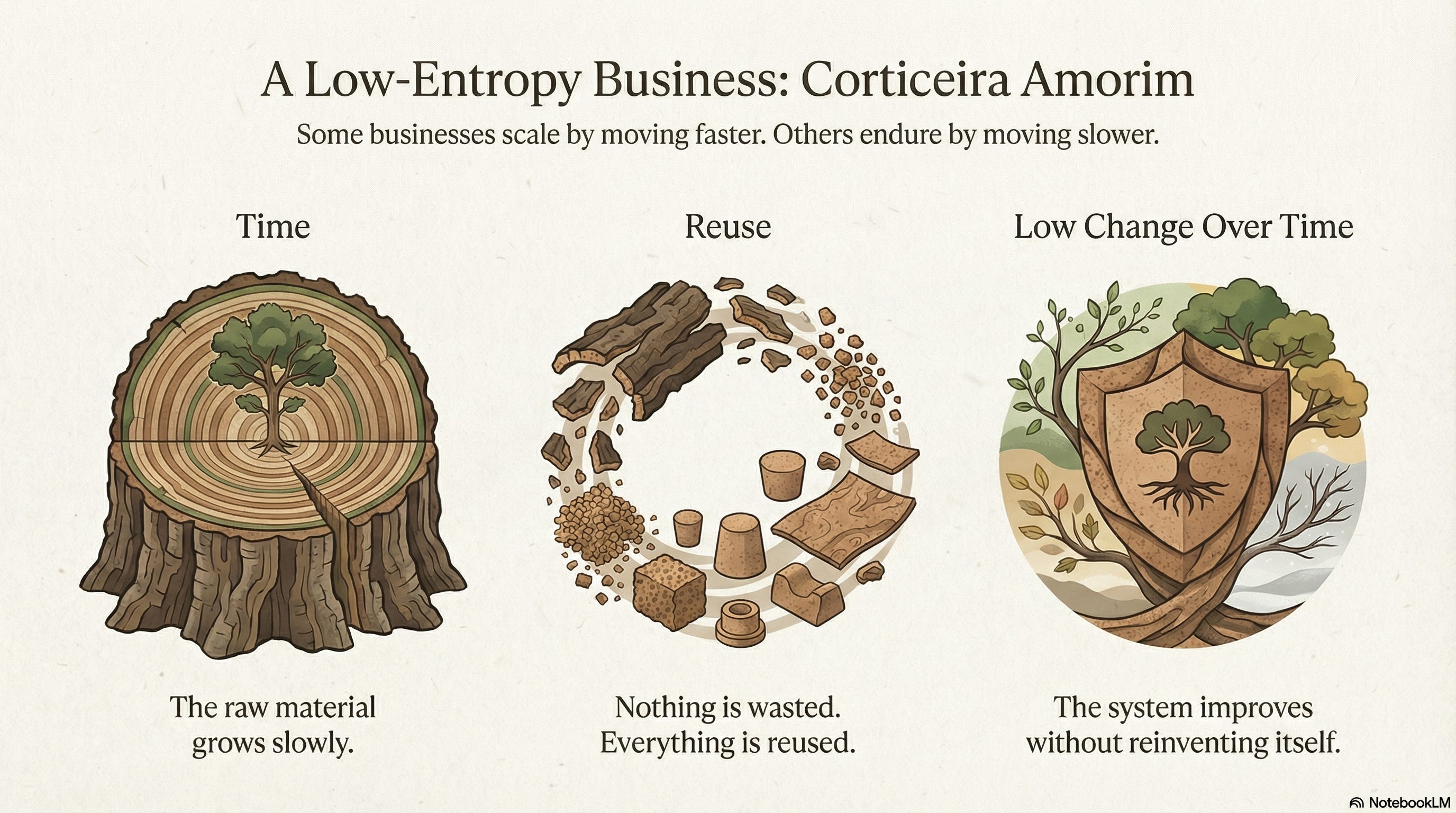
Corticeira Amorim is the global leader in cork processing, but that description misses the point. This is not a manufacturing story. It is a time story. The raw material grows slowly, regenerates slowly, and improves with age. No software update can accelerate it. No breakthrough can compress it. The supply chain moves at the pace of biology.
That pace imposes order.
The company’s structure mirrors this constraint. Corticeria controls the entire lifecycle of cork, from forest management to final applications. Forests are managed decades ahead of demand. Raw material is prepared centrally. What can’t become a wine stopper becomes flooring. What can’t become flooring becomes insulation. What can’t become insulation becomes energy to power the factory itself.
Nothing is rushed. Nothing is wasted.
This is where most businesses introduce entropy: leftovers, exceptions, inefficiencies. Amorim does the opposite. Every fragment has a destination. Even cork dust is burned as biomass to fuel production. Waste does not accumulate because the system does not allow it to exist.
Order is engineered into the process.
At the surface, the company looks diversified. Wine stoppers. Construction materials. Aerospace components. Transportation. Energy. Sports surfaces. Fashion. Toys. But this is not diversification in the financial sense. It is reuse at scale. One material. One biological input. Many outcomes.
Think of cork as nature’s high-tech foam. Lightweight. Compressible. Insulating. Fire resistant. And endlessly recyclable. Corticeira doesn’t chase new markets; markets keep finding new uses for cork. From sealing a bottle of wine to protecting a spacecraft during re-entry, the material stays the same. Only the application changes.
That stability matters.
Innovation exists here, but it plays a different role. R&D is not about reinventing the business. It is about refining the material. Cleaning it better. Shaping it differently. Adapting it to new technical requirements without altering the underlying system. Innovation reduces entropy instead of introducing it.
The company’s sustainability narrative often gets framed as ESG. That misses the deeper point. Sustainability is not an overlay. It’s a consequence. When your raw material regenerates itself, and your process extracts value from every molecule, environmental alignment stops being a tradeoff and becomes a structural advantage.
The forests outlast management teams. The trees outlive product cycles.
This is why Corticeira Amorim feels almost immune to the forces that destabilize most businesses. There is no sudden obsolescence risk. No platform shift. No winner-takes-all dynamic. The competitive advantage is not technological or financial. It’s temporal.
The business changes slowly because it has to. And because it has to, it stays ordered.
Most companies fight entropy by adding layers: systems, dashboards, committees. Corticeira avoids entropy by accepting a simple truth: some resources cannot be accelerated. When you build around that constraint instead of fighting it, the entire organization settles into a natural rhythm.
Trees grow. Bark regenerates. Value compounds.
In investing, we often talk about businesses that scale. Corticeira Amorim is different. It endures. And in a world where everything seems designed to break faster, endurance may be the rarest advantage of all.
Costco — A business that wins by saying no
The store feels unfinished.
The concrete floor is bare.
Boxes sit on pallets.
Signs look temporary.
There are no aisles designed to inspire browsing.
And yet, every cart is full.
That contradiction is the first clue to understanding why Costco is a low-entropy business.
Most retailers try to win by offering more: more choice, more brands, more promotions, more personalization. Costco does the opposite. It removes options. Relentlessly. And in doing so, it creates order.
Walk into a typical supermarket and you face tens of thousands of decisions. Which brand? Which size? Which promotion? Costco cuts that chaos down to fewer than four thousand items. Often, just one version of a product. Sometimes two. Rarely more.
The customer doesn’t decide. Costco already did.
That is the system.
The membership card makes this even clearer. You pay before you shop. The transaction begins long before you reach the checkout. That single step flips the entire economic relationship. Costco no longer needs to extract profit from every item. The annual fee covers most of the overhead. Everything else can be sold at razor-thin margins.
The incentive to confuse disappears.
This is where entropy usually enters retail: markdowns, seasonal resets, promotional noise, constantly changing layouts. Costco avoids all of it by anchoring the model around trust. Members don’t come to discover new things. They come to buy known things at fair prices, again and again.
Repetition becomes a feature, not a flaw.
Behind the scenes, the same philosophy applies. Warehouses are simple by design. Products stay on the pallets they arrived on. Inventory moves fast. Handling is minimized. Complexity is treated as a cost, not a competitive advantage. The fewer steps something takes, the fewer things can go wrong.
Even cash behaves differently here. Inventory often sells before suppliers are paid. Time works in Costco’s favor, quietly smoothing the operation. Nothing flashy. Nothing heroic. Just a system that compounds small efficiencies day after day.
The same logic extends to people. Employees stay. Careers last decades. Managers are promoted from the floor. Knowledge accumulates instead of leaking out. In an industry known for churn, stability becomes another form of cost control.
What makes Costco unusual is not scale or pricing power. Plenty of companies have those. What makes it unusual is discipline. The discipline to say no to selection. No to aesthetics. No to short-term margin expansion. No to optimization that adds friction.
Most businesses accumulate entropy by adding layers. Costco reduces it by subtracting them.
The result is a company that barely needs to change. The core rules have held for decades. Members trust the price. Suppliers respect the volume. Employees understand the culture. The system runs because it is simple enough to be understood and repeated.
That simplicity is hard to copy. Not because it is complex, but because it requires restraint.
Where retailers fight for attention, Costco operates like a cooperative with a building. It doesn’t try to excite you. It tries to serve you. And because it does, the business remains calm while everything around it accelerates.
Some companies grow by expanding choice.
Others endure by removing it.
Costco belongs to the second group. Its low entropy comes not from innovation, but from consistency. From a refusal to complicate what already works. From the quiet confidence that fewer decisions—made well—are better than many decisions made often.

Conclusion
We often talk about business success as if it were a race against time. Faster growth. Faster innovation. Faster response. The assumption is that endurance comes from speed.
The companies in this essay suggest something different.
They endure because they are built around forces that do not accelerate easily. Death does not move faster. Trees do not grow on command. Habits formed through trust do not need constant redesign. These businesses do not fight time; they align with it.
Their advantage is not superior forecasting or clever strategy. It is restraint. The discipline to accept limits. The patience to repeat what works. The confidence to leave certain things untouched.
Low entropy is not about avoiding change. It is about deciding where change is allowed to happen—and where it is not.
Most organizations accumulate disorder by adding. New products. New processes. New exceptions. Over time, the system demands more energy just to stay in place. These businesses do the opposite. They remove decisions. They narrow variation. They build structures that can be run without constant intervention.
That is why they feel calm.
In investing, we spend enormous effort trying to predict what will change next. Perhaps we should spend more time identifying what is unlikely to change at all. Human rituals. Biological cycles. Simple rules that scale quietly.
Durability is not always about doing more.
Sometimes, it is about needing less.
And in the long run, order compounds just as reliably as growth.
If you’d like to keep reading pieces like this one, I’d be glad to have you as a subscriber.
Ezra’s Notes is free, and it helps me write more essays worth your time.