


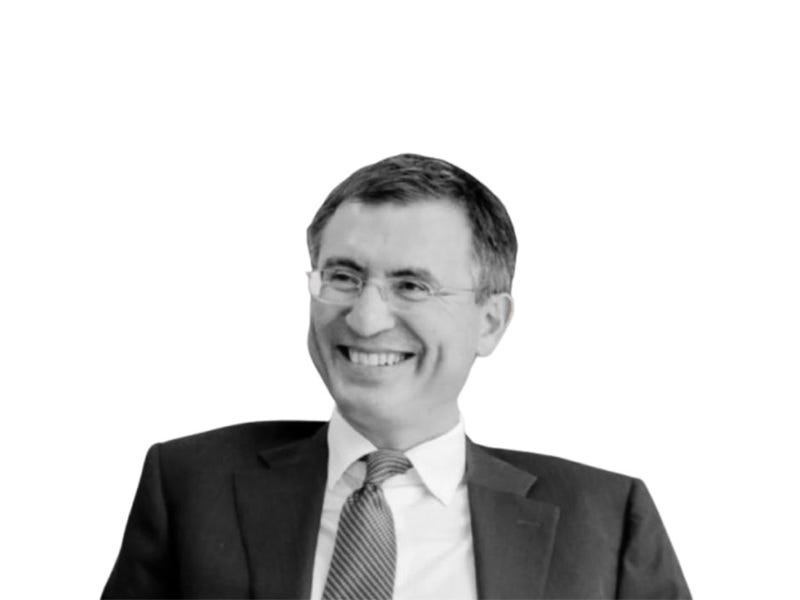
Would you change your wife every year?
That was Chris Hohn’s answer when someone asked why he doesn’t rotate his portfolio more often.
Chris is the founder of TCI Fund Management. Over more than two decades, he’s compounded capital at 18% annually — roughly 9 points ahead of the market.
His philosophy: invest in quality companies, run a concentrated portfolio, and hold positions for years — some, like Moody’s, for more than a decade.
And like every great investor I’ve studied, he’s taught me a few things worth passing on.
First, eliminate
Most investors go looking for good ideas. Chris does the opposite: he eliminates almost everything before he even starts.
Banks. Airlines. Telecom. Media. Insurance. Commodities. Utilities. Asset managers. Oil & gas. Retail.
Why so ruthless? In his own words:
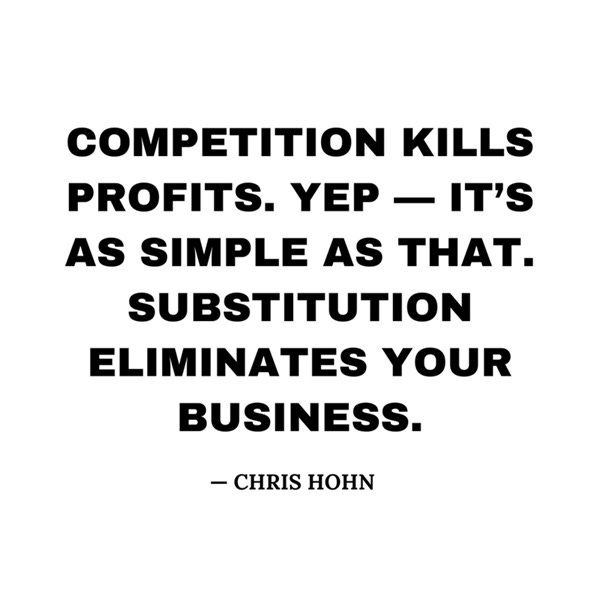
His argument is straightforward: in competitive industries, profits tend toward zero over time. It doesn’t matter how fast the sector grows.
Growth without barriers is worthless.
After that filter, Chris considers about 200 companies in the entire market investable — high quality enough to own. Two hundred, out of ~58,000 publicly listed companies.
This reminded me of Rupal Bhansali, a portfolio manager at Ariel Investments. She arrives at the same place, but through process rather than industry. She flips the analyst’s default posture: every company starts out rejected, not selected, and has to prove it belongs.
And both share the same rule number one:
Instead of focusing on making money, first try not to lose it.
— Rupal Bhansali
Moats, moats, and moats
Once inside that narrowed universe, Chris has one obsession: what protects this business from competition? Not just any moat — durable ones. And ideally, more than one.
Irreplaceable physical assets
Airports, toll roads, cell towers, railroads. Nobody is going to build a second airport in Madrid. Nobody is going to lay a second set of tracks right next to the existing ones. These are natural monopolies.
This connects to something I wrote a while back about Grupo Aeroportuario del Centro Norte (OMA), an airport operator in Mexico. Nobody would build a second airport in Monterrey. OMA doesn’t need to reinvent air travel. It just executes within lines that were already drawn. This is a low-entropy business. Chris, without using that term, is looking for exactly the same thing.
Advanced intellectual property
His favorite example here: jet engines — and it shows. GE Aerospace GE 0.00%↑ , at roughly 33% of the portfolio, is his single largest position. There are only two players in narrow-body engines and two in wide-body. There hasn't been a new entrant in over fifty years. The engines run at temperatures so high that metals melt. Thousands of complex parts. It's simply too hard to replicate.
Network effects
Visa V 0.00%↑ , his second-largest position, is his textbook case. Every new customer and every new bank that joins the network makes it more valuable for everyone else — and harder to displace.
Switching costs
Microsoft MSFT 0.00%↑ used to be the classic example in Chris's portfolio — until it wasn't.* With Office, Teams, and Azure all under one roof, switching costs are high.
Installed base
Back to jet engines: once the engine is on the wing, the airline depends on you for parts and maintenance for decades. It’s a recurring revenue stream that doesn’t require winning the sale over and over again.
The question Chris asks about every investment isn’t “can this company grow?” It’s “can someone else come in and compete with it in twenty years?”
If the answer is clearly no — invest. If there’s any doubt — pass.
The most common mistake: confusing growth with value
If there’s one thing the consensus loves, it’s growth — and it mistakes that growth for value. Growth only has value when it comes with barriers. Without them, growth benefits customers and competitors — not shareholders.
For Chris, growth itself isn’t the problem. What he wants are what he calls “super-companies”: ones that can raise prices above inflation, year after year. Pricing power at its purest.
Moody’s MCO 0.00%↑ , his third-largest position, is the clearest example. It’s grown revenue at 10% a year for a hundred years. The company has pricing power, a captive customer base that can’t function without it, and virtually no real competition.
Time as a competitive advantage
Hohn’s average holding period is 8 years. That’s not just patience as a virtue. It’s a structural rule for the portfolio.
Why? Because the market prices companies looking 2 or 3 years out. If you’ve found a business that will still be excellent in 20 years, the market gets it wrong. The gap between what the market sees and what you see — that’s your edge.
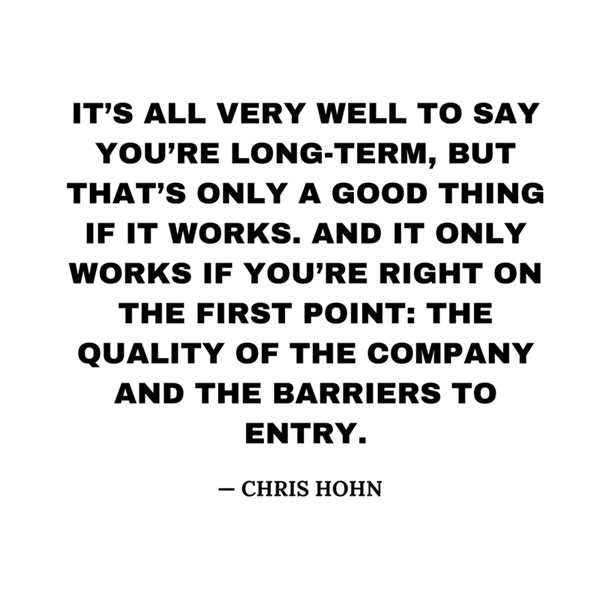
But there’s a catch: holding onto a quality company only works if the fundamentals were right to begin with — if the moat is real and durable.
Final Thoughts
Chris’s investment philosophy comes down to three questions:
Does this company have real, durable moats?
Can it raise prices above inflation?
Can you hold it for 10 years with conviction?
And it sums it all up in one line:
What kills you as an investor is permanent loss of capital.
And the best way to avoid permanent loss is to stay out of industries where competition can destroy you, not overpay for growth without a moat, and not sell what’s genuinely great just because the market is asking you to.
Find the right company. Understand it deeply. And don’t change it every year.
Chris’ Checklist
Avoid banks, airlines, telecom, media, insurance, commodities, utilities, retail, oil & gas, and asset managers.
Find a real, durable moat: irreplaceable physical assets, hard-to-replicate IP, network effects, switching costs, or an installed base.
Make sure it holds up against competition, technology, and 20 years of time.
Confirm pricing power, year after year.
Hold it for the long-term, with conviction.
* TCI cut its Microsoft position from 10% to 1% of the portfolio in Q1 2026, then exited entirely in Q2. Chris's reasoning: "Rapid progress in AI creates uncertainty around Microsoft's future competitive position. We are primarily concerned about the Microsoft Office productivity software franchise: AI could change established workflows and lead to new work platforms. In addition, we see some risks to [cloud service] Azure." (Source: en.oninvest.com)
