


Domino’s DPZ 0.00%↑ barely sells pizza.
Of every $100 it takes in, $60 comes from selling dough, cheese and boxes to the people who own the stores. Another $21 is royalties and fees, a cut of every pizza someone else sells. Only $8 comes from its own stores. The last $11 is advertising money that passes through its books and leaves.
That is why it’s such a good business. The franchisee pays for the store, the oven and the drivers. DPZ collects. With that model, EPS quadrupled between 2016 and 2025.
It is also why the company has a problem that doesn’t show up in its accounts. Domino’s doesn’t decide how many stores open. That call belongs to someone who puts about $400,000 of their own money on the line and runs the numbers. Those numbers look worse today than in 2019, and it shows. The company promised 1,100 new stores a year. It opened 775 in 2024 and 776 in 2025.
The market still prices Domino’s as if it will grow the way it used to. At $303/share, the stock assumes 11% annual growth for 5ys. Management promises 8%. The business has delivered 5%.
It’s a good business, and at this price it’s expensive. Below I explain both.
(Full research report at the end of this post)
The Thesis
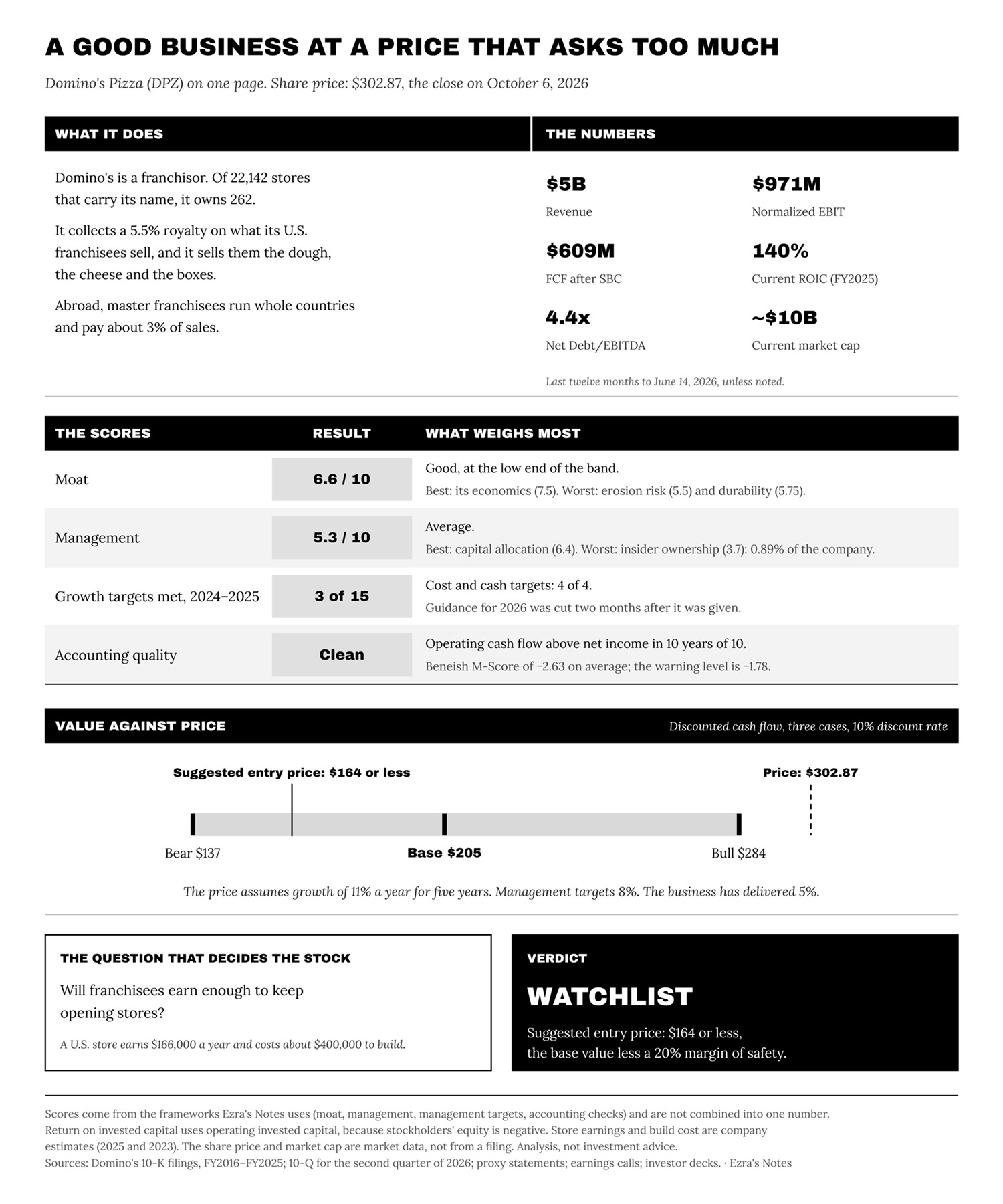
DPZ is a tollbooth. It collects 5.5% of sales from 6,924 U.S. stores it doesn’t own, and it sells them their supplies too. 99% of franchisees renew. Cash comes in as fast as profit: operating cash flow beat net income in each of the last 10y. And for a decade it has been taking customers from its rivals.
The last decade won’t repeat. Almost half the growth in EPS came from lower taxes and buybacks funded with debt. Franchisees pay for the growth, and their stores earn less than they used to. Management promises more than it delivers. And in July 2027, Domino’s has to refinance $1.3B of debt at higher rates.
Will franchisees earn enough to keep opening stores? If the math works for them, Domino’s grows almost for free. If it doesn’t, Domino’s stops growing, however good its business is.
A toll on every pizza
There are 22,142 stores with the Domino’s logo around the world. The company owns 262 of them. Franchisees own the rest: they rent the space, hire the drivers and bake the pizzas. Domino’s supplies the brand, the app, the advertising and the dough, and charges for all of it.
The company reports three segments:
U.S. stores: royalties and technology fees from franchisees, the advertising fund and the 262 company-owned stores. It brings in 33% of revenue and 49% of profit.
Supply chain: 30 centers in the U.S. and Canada make the dough and deliver ingredients to more than 7,800 stores. It is 60% of revenue but keeps only about 11 cents of each dollar it sells, and Domino’s hands half of that profit back to franchisees. Buying from it is optional.
International franchise: 14,956 stores in more than 90 markets, each run by a master franchisee that pays about 3% of its sales. It is 7% of revenue and 24% of profit. With no cost of goods to speak of, 85 cents of every dollar ends up as profit.
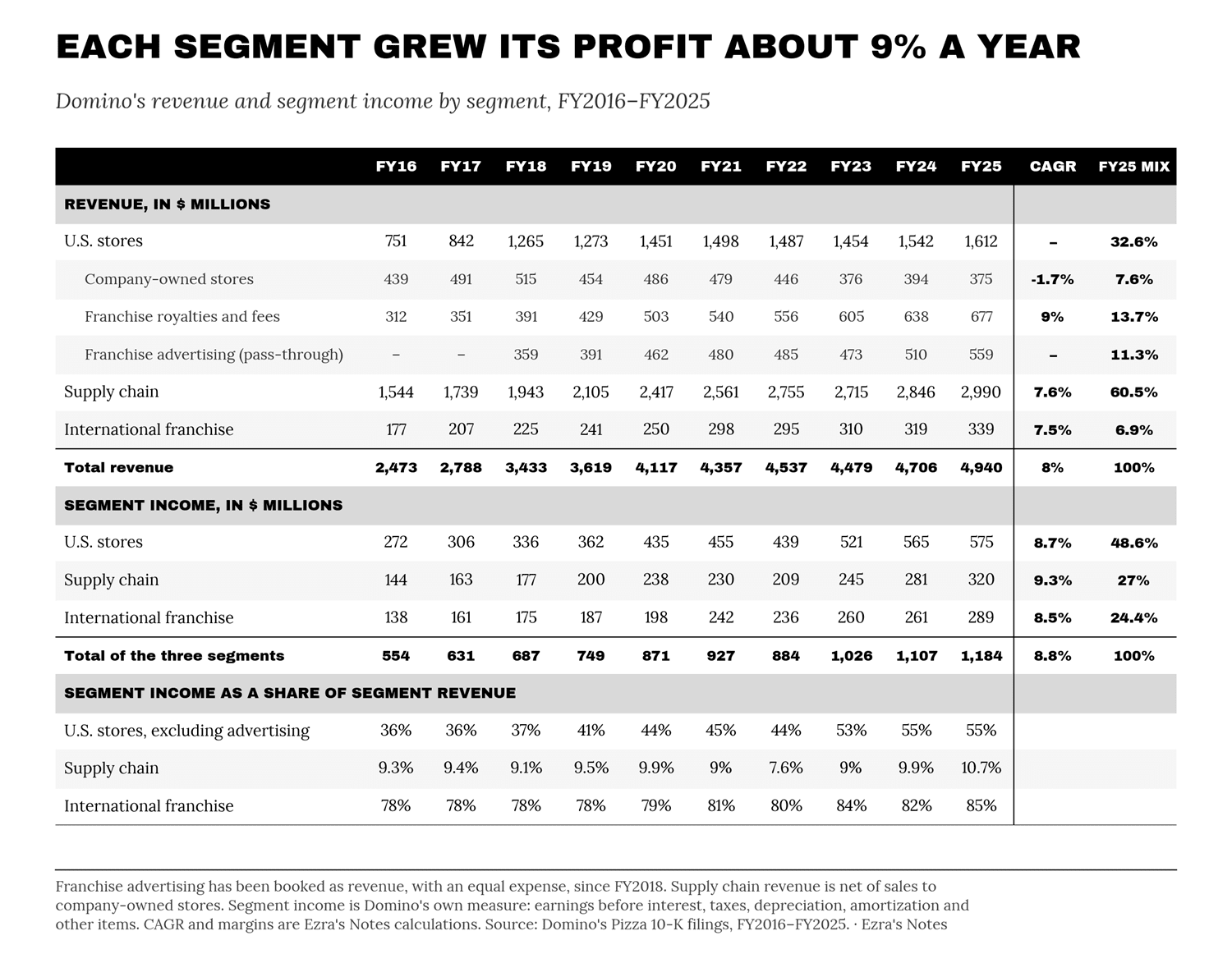
Over 10y, all three grew at almost the same pace. Excluding the advertising fund, revenue rose 6.6% a year, and each segment’s profit grew between 8.5% and 9.3%.
Two crises tested the model. Between 2006 and 2009, operating income fell 11.5%. The stock still lost 81% during 2008, because a year earlier Domino’s had borrowed up to 7.6x its EBITDA. In 2022, inflation cut store profits by about 20%. Demand held up both times. What broke first was the balance sheet, and then the franchisee’s wallet.
That is where the model hits its limit. Domino’s grows when stores open, and someone else pays for the stores. From 2016 to 2019 the system added about 1,120 net stores a year. From 2022 to 2025, about 820. The average U.S. store now earns $166,000 a year, against $133,000 in 2016. That is 2.5% a year, over nine years in which Domino’s own operating income doubled.
Why Domino’s wins
Americans spend $43.4B a year on quick-service pizza, and the market grows 2.5% a year. The chains say they compete on quality, service, technology and price. In practice they compete on two things: the price of this week’s deal and how long the pizza takes to arrive. Nobody has pricing power. Customers lose nothing by switching chains.
Even so, market share has moved in one direction. Domino’s holds 23.3% of the market. Between 2015 and 2023 it gained 9.4 points, while Pizza Hut, Papa Johns PZZA 0.00%↑ and Little Caesars together lost 3.4 most of what Domino’s gains comes out of its big rivals.
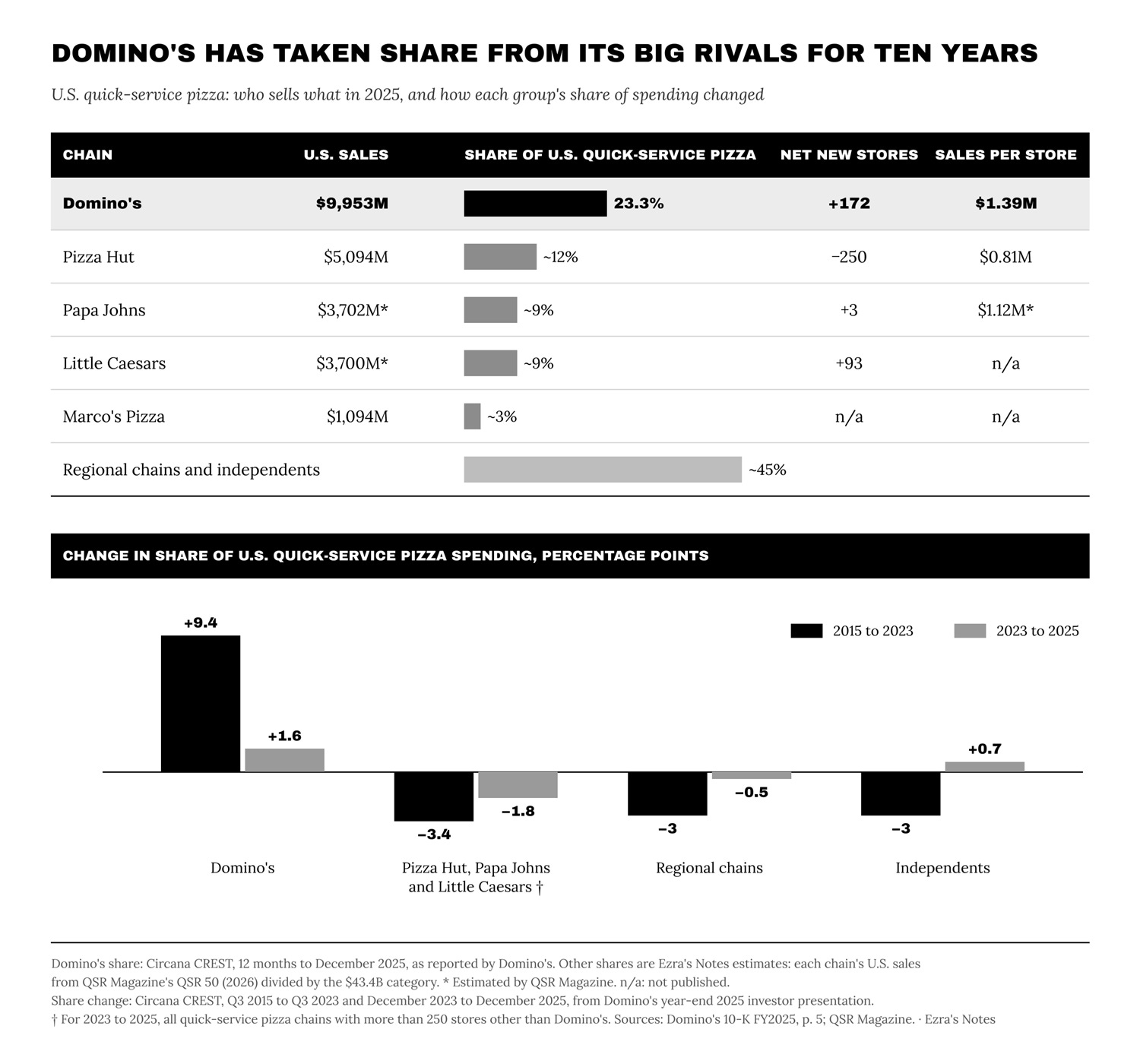
Size explains it. DPZ advertising fund raised $559M in the U.S. in 2025. Pizza Hut’s raised $360M worldwide. One supply chain buys the cheese and flour for the entire system. So the same deal leaves more money in a Domino’s store, which sells $1.39M a year, than in a Pizza Hut, which sells $0.81M. CEO Russell Weiner put it this way in February: “We have profit power.” Domino’s can sell cheap and its franchisees still make money.
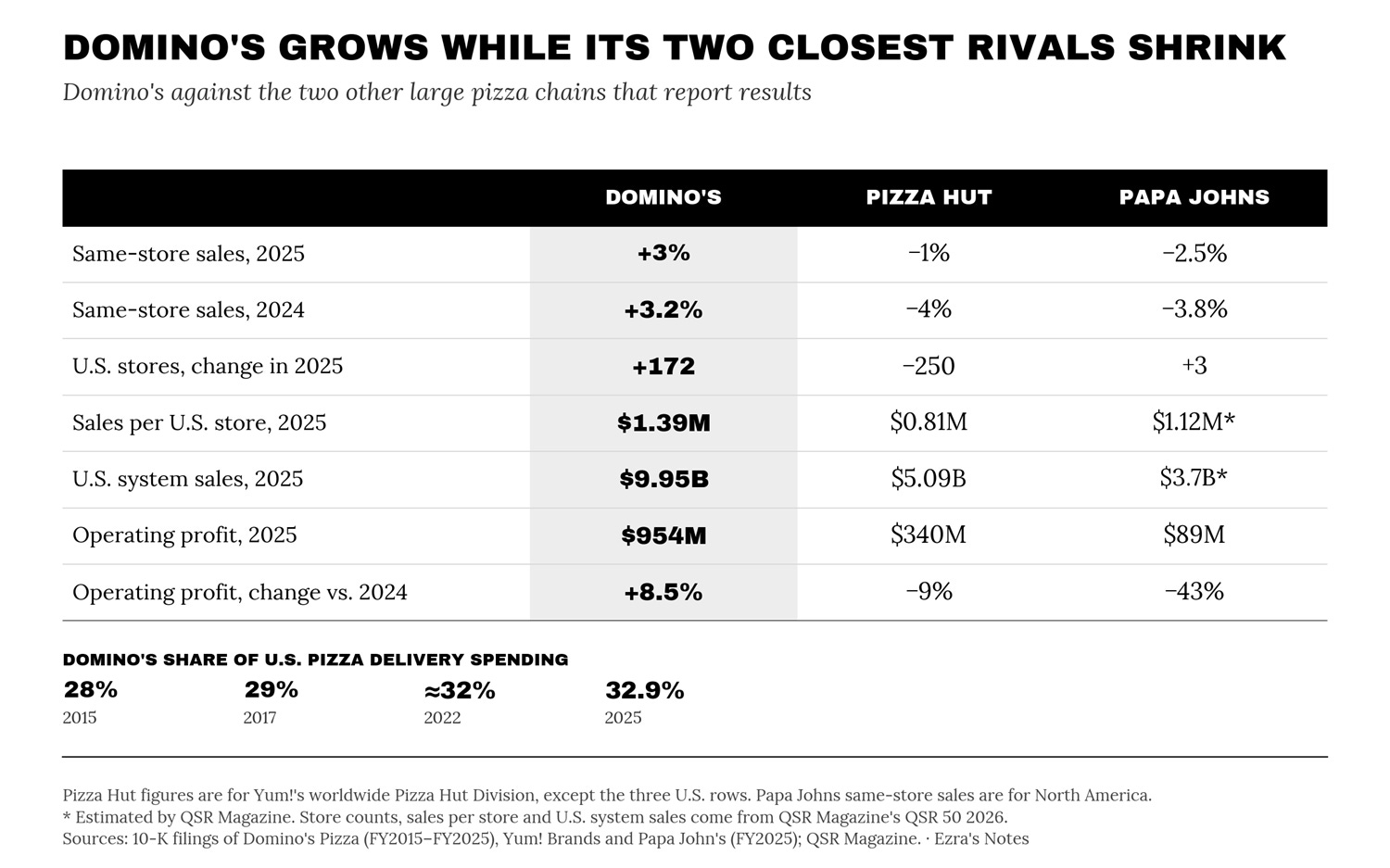
What it doesn’t have is a captive customer. Independent pizzerias and regional chains still take about 39% of delivery. And the barrier that held them back, the cost of running their own drivers, fell when Uber Eats and DoorDash arrived. Domino’s refused to sell on those apps for years. It joined them between 2023 and 2025.
Meanwhile, the rivals are retreating. Pizza Hut closed 250 U.S. stores in 2025, and Yum! Brands YUM 0.00%↑ sold it to a private equity firm in September 2026. Papa Johns closed 101 restaurants in North America in the first half of 2026 and suspended its dividend.
Management delivers cash, not growth
Domino’s management promises more growth than it delivers, and when it misses, it moves the goalposts.
In January 2019, management talked about 25,000 stores and $25B in sales by 2025. It ended that year with 22,142 stores and $20.1B. In December 2023 it unveiled a new plan through 2028: 1,100 net new stores a year, sales growing 7% and operating income growing 8%. The store target lasted seven months. In July 2024 the company suspended it “temporarily,” and the stock fell 13.6% that day. Nineteen months later it was still suspended. The 2026 guidance was cut two months after it was issued.
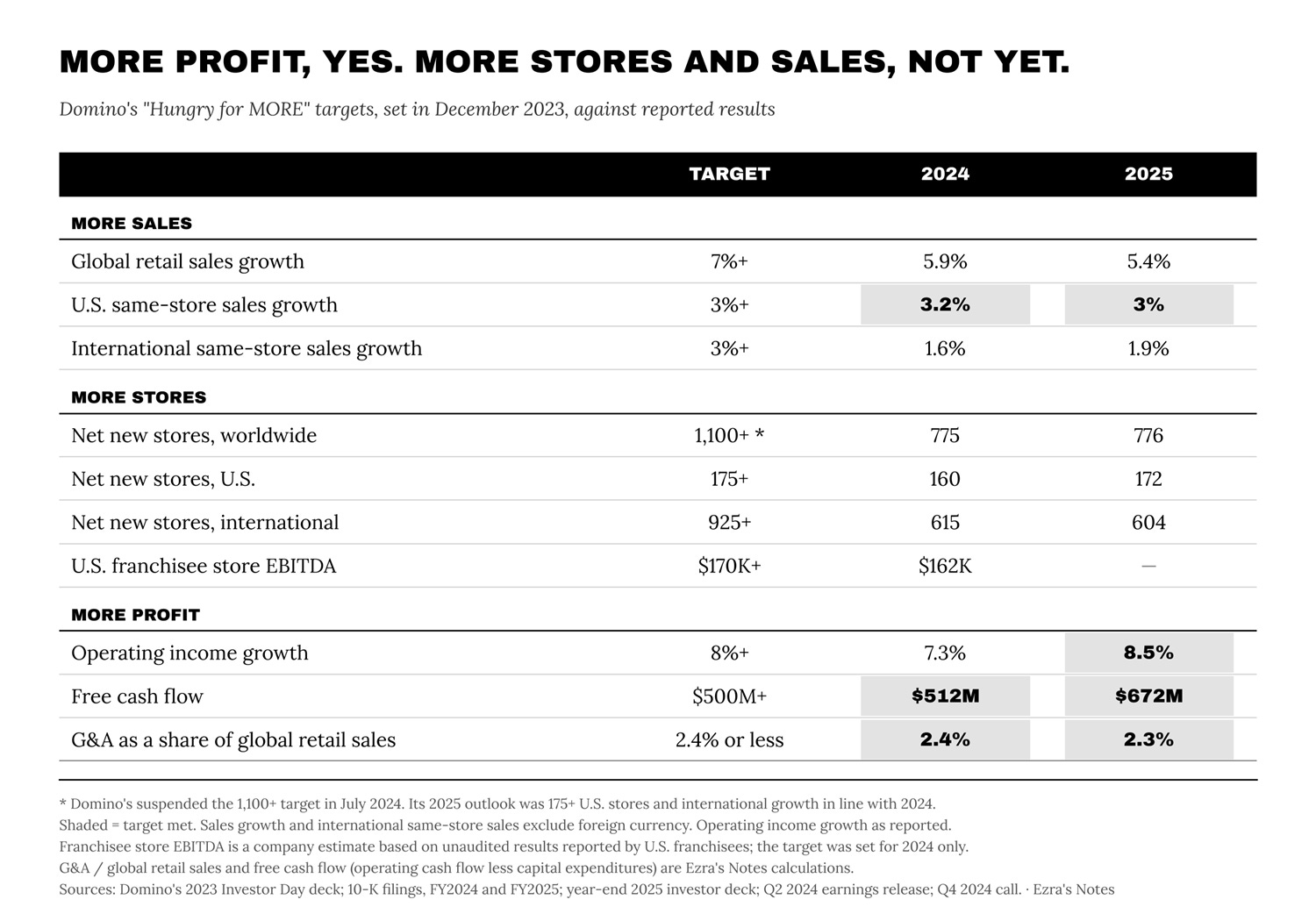
Of 15 growth targets for 2024 and 2025, the company hit three. It hit all four of its cost and cash targets. It delivers what it controls and misses what depends on franchisees wanting to open. That’s why I value Domino’s on what it has delivered, not on what it promises.
The pay plan doesn’t help. The CEO earned $10.7M in 2025, and only 9% of it was fixed. The bonus and most of the stock awards depend on an adjusted EBITDA figure that the compensation committee defines itself. FCF, ROIC, per-share results and store openings all go unmeasured. When results fell short in 2022, the committee changed the rules. In January 2023 it lowered the bonus target a month after setting it, and it redesigned the performance shares. The first cycle under the new rules paid out at 121.8%, after the two before it paid 98.5% and 59.6%. And the internal targets that trigger pay ask for less than the company promises in public.
Management doesn’t own much of the company either. Directors and executives hold 0.89% of Domino’s, down from 3.57% at the end of 2016. The CEO’s own shares are worth about $8.9M, less than he was paid in 2025. Since 2016 there has been exactly one open-market purchase by an insider. The real owner sits outside: Berkshire Hathaway holds 9.96%.
As for the cash, the company reinvests little, earns a lot on it, and returns the rest. The problem is the price it pays for buybacks. Between 2016 and 2019 it bought back 12.8M shares at an average of $207, and those shares are worth 46% more today than they cost. From 2020 to 2025 it paid an average of $421. Those shares cost $2.87B and are worth about $2.07B today, 28% less. Nobody at the company tells the two apart in public, and neither does the pay formula.
Lots of cash, little capital, plenty of debt
Between 2016 and 2025, Domino’s sales excluding advertising grew 6.6% a year. FCF/share, after stock-based compensation (SBC), grew 15.1% a year, from $5.17 to $18.31.
Not all of that gap came from the business. Operating income grew 8.6% a year and accounts for 53% of the growth in EPS. The rest came from three places: 31% fewer shares outstanding, a tax rate that fell from 37.7% to 21.9%, and interest costs that grew more slowly than profit. The tax cut won’t repeat. And part of the buybacks was paid for with debt.
What makes DPZ unusual is how little capital it needs. Franchisees pay for the stores, so Domino’s is left with distribution centers, software and working capital: $533M at the end of 2025. On that base it generated $792M of operating cash flow. ROIC was 140% in 2025 and averaged 154% over 10y.
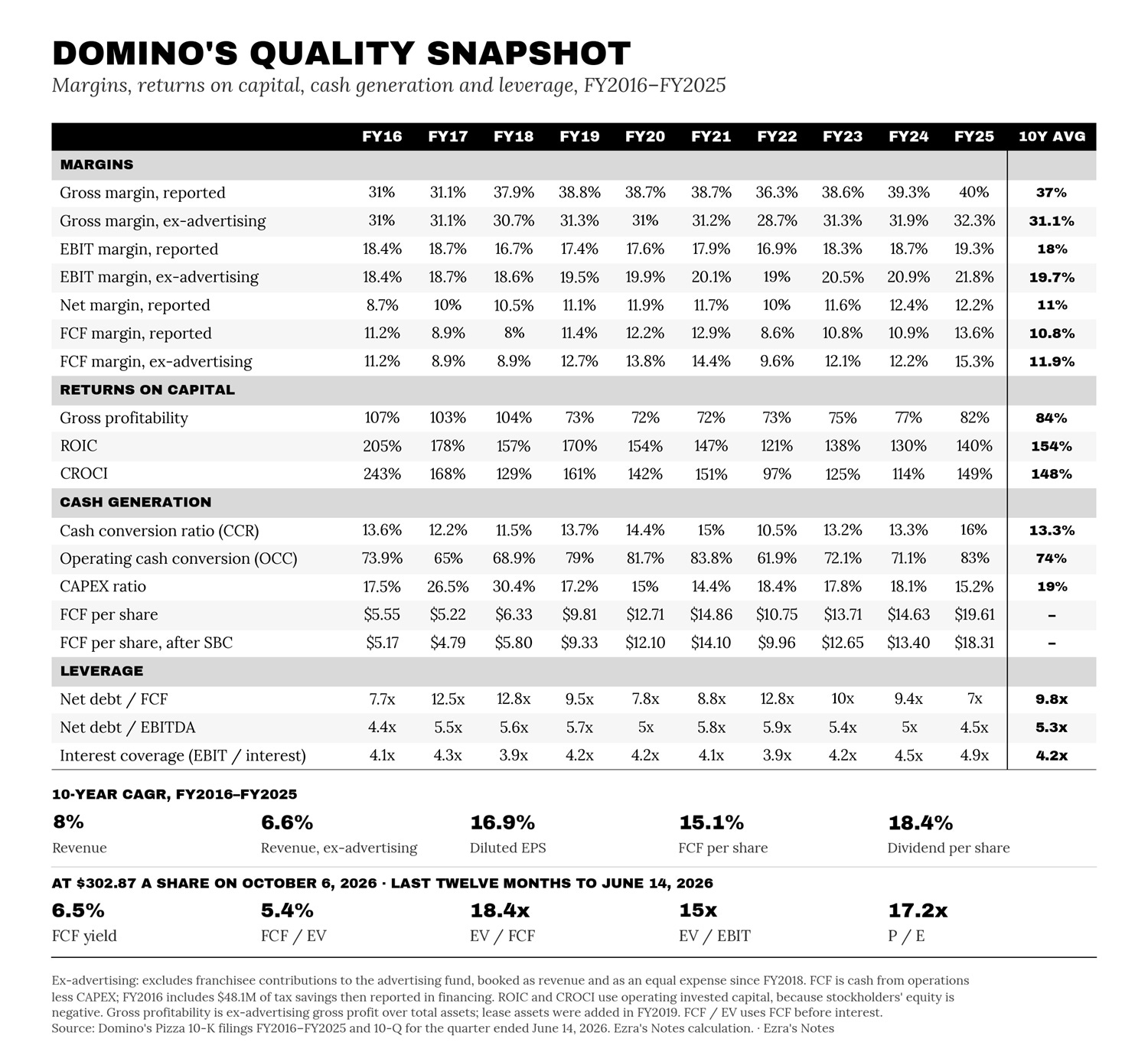
Then there’s the debt. Domino’s owes $4.8B, 4.4x EBITDA. The notes carry fixed rates and are backed by royalties and the brand. Relative to cash flow the load hasn’t grown: since 2016 debt has risen 2.2x and FCF 2.4x.
What I’m watching is the cost of rolling it over. In July 2027, $1.3B comes due, about a quarter of all its debt, at an average rate of 4.2%. The notes Domino’s issued in September 2025 already priced at 4.93% and 5.22%, and the five-year Treasury yield has since climbed from about 3.7% to 5.06%. At the same spread it got in 2025, Domino’s would pay about 6.3%. If all five series maturing between 2027 and 2031 moved to that rate, interest would rise by about $103M a year, more than half of what Domino’s paid in 2025.
Do I trust the numbers? Yes. Operating cash flow beat net income in all ten years, the Beneish M-Score averages −2.63, well below the −1.78 line that flags possible manipulation, and there are no restatements and no acquisitions to hide anything in. The one caveat is 2025. Cash flow got a lift that year because Domino’s paid its suppliers later. Strip that out and FCF was $574 million, which is the figure I use to value the company.
What it’s worth
At $302.87/share, Domino’s has a market cap of ~$10B, roughly what its U.S. stores ring up in a single year. Add the debt and the enterprise value is $14.7B.
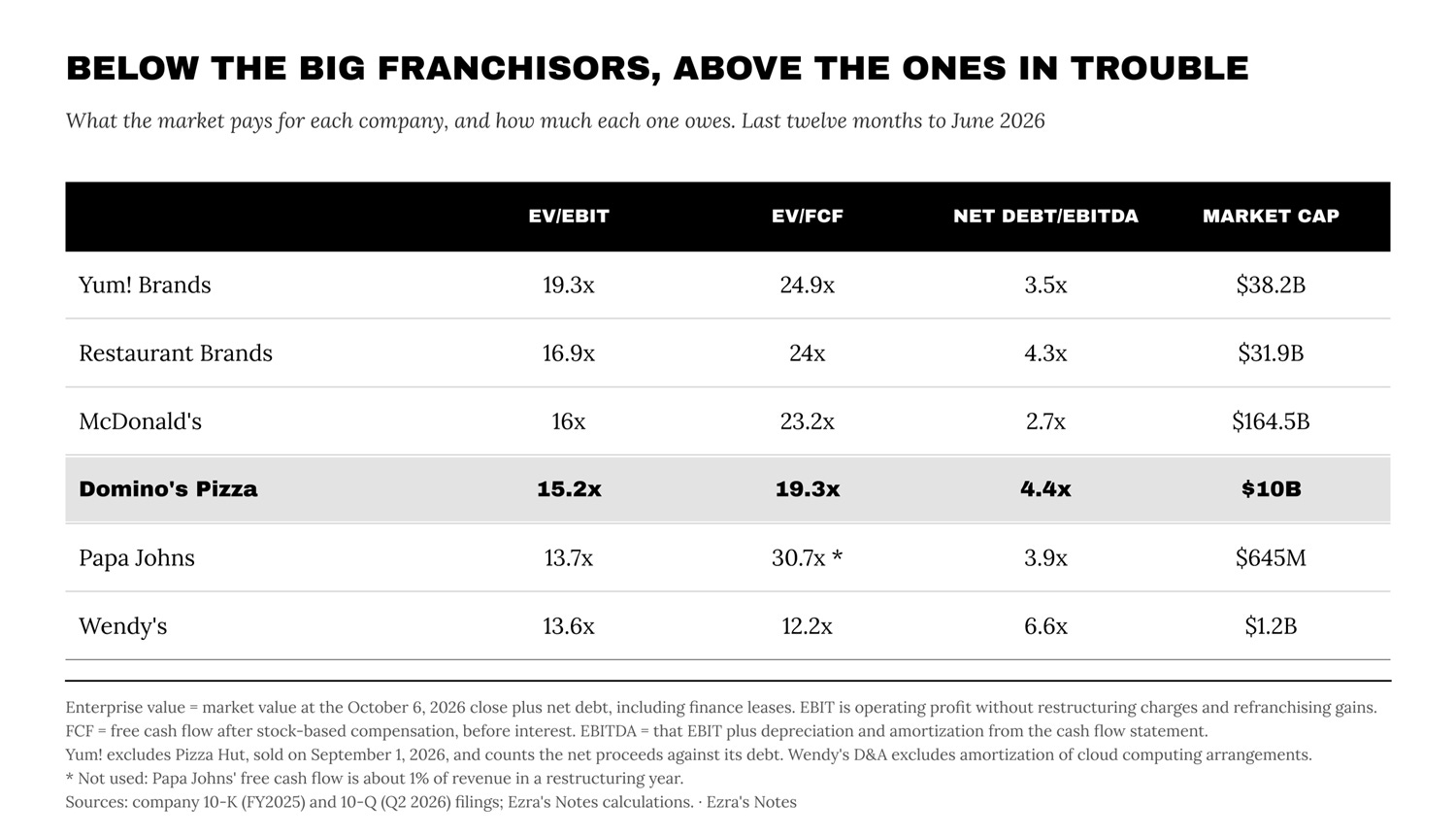
First, where it trades. Against five other franchisors, Domino’s sits in the middle: 15.2x operating income, versus 16 to 19x for McDonald’s MCD 0.00%↑ , Yum! Brands and Restaurant Brands International QSR 0.00%↑ . On cash flow the gap is wider, 19x against 23 to 25, because Domino’s needs less investment. At the peer median, the stock would be worth somewhere between $328 and $403. That tells me it isn’t expensive relative to its peers. It doesn’t tell me what it’s worth.
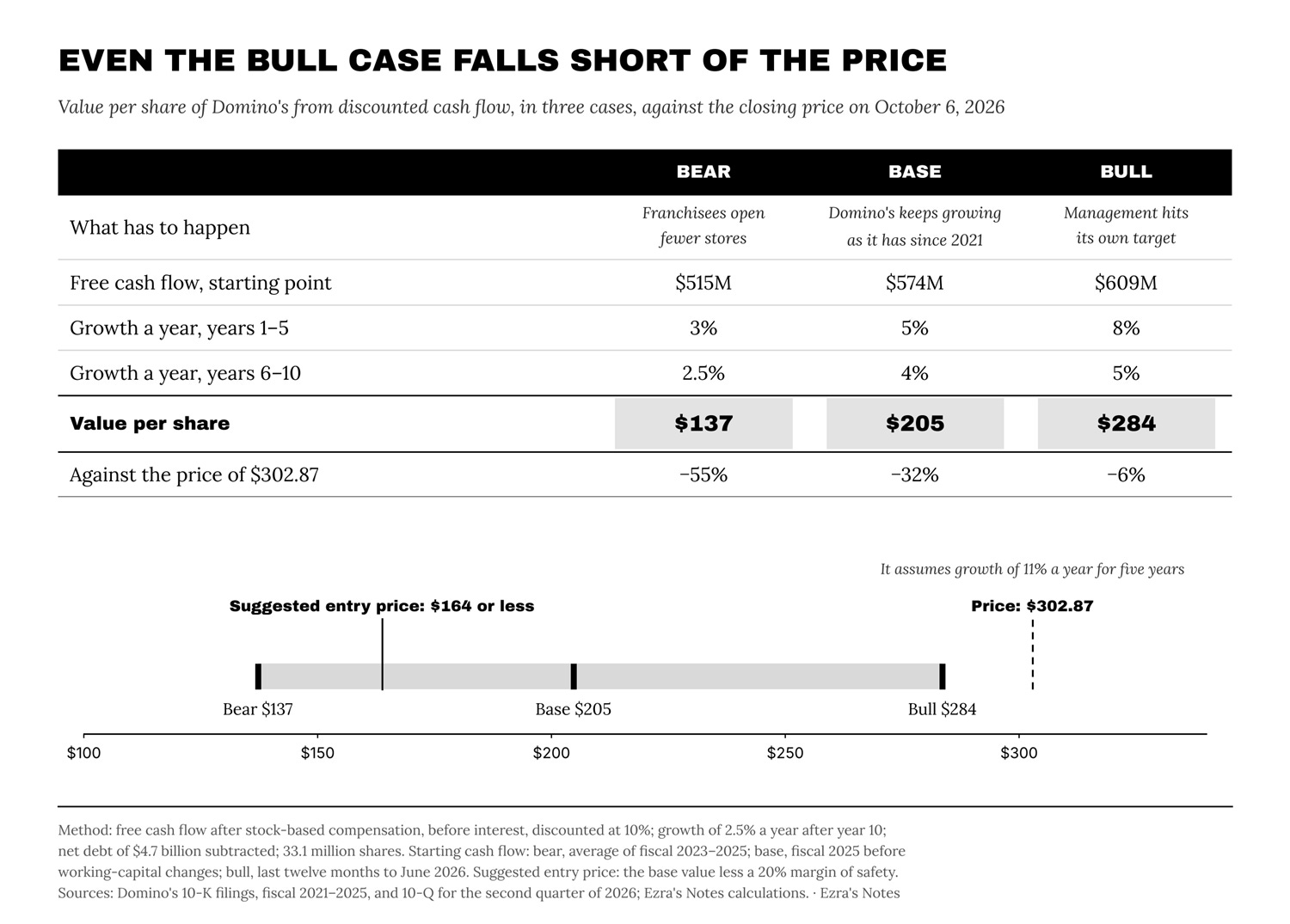
For that, I project its cash flow ten years out and discount it back at 10%. My rule is simple: more risk, higher rate. The business is stable. The balance sheet less so, and growth depends on someone else’s wallet.
I ran three stories:
• Bear case, $137/share: franchisees open fewer stores and cash flow grows 3% a year.
• Base case, $205: Domino’s keeps growing 5%, what it has delivered since 2021, starting from the $574M of 2025.
• Bull case, $284: management hits its 8% target for five years.
Management’s target sits in the bull case rather than the base case because of the track record: 3 out of 15.
Then I ran the math backwards. For the stock to be worth $303, DPZ would need to grow 11% a year for 5y. That’s more than it promises and twice what it delivers. If my base case is right, a buyer today earns 8.4% a year. Not a bad result, but below the 10% I require.
Conclusion
Domino’s stays on my watchlist. At $303, the price leaves no margin of safety.
It’s a good business. It takes a cut of every pizza while putting up almost no capital, turns its profit into cash, and has spent a decade taking customers from rivals that are now closing stores. What changed is the pace. For ten years EPS compounded at 17%, and almost half of that came from taxes and debt. What’s left is a business growing 5% a year, run by a management team that promises 8%.
For a business of this quality I want a margin of safety of at least 20%, which means buying at least 20% below what it’s worth. Against my value of $205, I think the sensible price to pay would be $164 a share or less. That’s a suggestion based on this analysis, not investment advice.
At $164, DPZ would trade at about 10x EBIT. That price may never come. I’d rather miss a good company than pay for growth that isn’t in the numbers yet.
DOWNLOAD THE FULL REPORT

DISCLAIMER
This analysis is for educational and informational purposes only. It is not investment advice or a recommendation to buy or sell any security.
Do your own research or consult an adviser before making any investment decision.
I have no position in Domino’s Pizza (DPZ).
Data as of the October 6, 2026 close.
Would you buy Domino’s at $303, or would you wait for something closer to $164?
If you think I got something wrong, say so in the comments.
And if you liked this post, share the love!