Reimar Scholz was 36 when a headhunter offered him one job: recruitment consultant. He read it as a verdict. He was no longer placeable as an employee.
So he started buying companies, the kind other owners wanted to get rid of. He began with €50,000 and acquired ten businesses in three years. Today he invests through Bavaria Industries AG, and what stands out in his writing is what he chooses to dwell on. Not the wins. The errors.
His biggest one fits in a single sentence. Russian shares that looked cheap by every conventional measure, about 5% of his portfolio, became unsellable almost overnight. He treated the war as too irrational to happen, and the loss changed how he sizes every position since.
In this interview, Reimar talks about how a failed job search became a company group, why he starts every idea by asking how it could go wrong, a UK franchisor he keeps adding to, and the seven questions he runs before buying anything.
One of them comes before all the others: “Can we survive being completely wrong?”
Tell me about your background and how you got into investing.
At 36, I hit rock bottom. After numerous job changes, a headhunter offered me a position only as a recruitment consultant, an unmistakable sign that I was no longer placeable as an employee. Only one path remained: to become an entrepreneur myself.
Without my own business idea, the only option was to buy an existing company. For two years I searched from home, relying on vague financing promises, for a suitable takeover candidate. The turning point came after a short internship with a professional company acquirer. There I learned to hunt specifically for businesses that others wanted to get rid of: true problem cases.
We started with €50,000 in equity and acquired ten companies in the first three years alone. Since then, through numerous acquisitions and investments, we have built something substantial. That is primarily the result of countless errors. Every false assumption and every failed investment forced us to re-examine our processes, and from that a system emerged, the BAVARIA Operating System, which has long-term outperformed the DAX and the S&P 500.
Most ambitious investors, and I was one of them, spend their time looking for the next Microsoft or Nvidia and too little on what could go wrong.
What’s your investment approach, and how has it evolved over time?
My focus has moved from upside to error reduction. Most ambitious investors, and I was one of them, spend their time looking for the next Microsoft or Nvidia and too little on what could go wrong. So we reversed the normal question. Besides “Why will this company succeed?”, we ask “What could prevent it from succeeding?”
Every mistake has to leave something behind: a rule, a warning sign or a better question for the checklist. A carmaker improves quality by tracking defects, and investing should work the same way. If you systematically reduce the number of losers, the winners naturally take up more room.
Some practices follow from that. For new or riskier investments we start small and average in, because a small first position gives us time to learn and stops us from defending a decision instead of analysing it. We write our theses down, keep an investment journal as a defence against self-deception, and sleep on decisions. And we prefer solid growth at a sensible price to expensive dreams. We hold very few classic growth stocks, apart from an Alphabet GOOG 0.00%↑ position we exited too early.
The Russian loss also changed how we think about country risk. In emerging markets we now spread our bets more widely and take some profits along the way. Over the past 20 years our returns have exceeded the S&P 500. That doesn’t prove we are unusually clever, but it suggests that avoiding serious mistakes can take you surprisingly far.
Tell me about one of your biggest investment mistakes, what happened, and what did you take away from it?
Our biggest mistake was Russia. Almost overnight, our Russian shares became effectively worthless. That was around 5% of our portfolio. Keep it in perspective: we lost capital, while people in Ukraine lost their lives.
We made two errors. First, we massively underestimated the probability of a Russian attack. We didn’t think war was impossible, but because the outcome looked irrational for everyone involved, we treated it as remote. Investors like to assume that leaders act in their economic self-interest, and politics doesn’t work that way. Second, we underestimated how severe and how fast the financial sanctions would be. Shares that looked extremely cheap became unsellable within days, so the value on the spreadsheet no longer mattered.
Shortly before the war, I was arguing at an investor conference that emerging markets were attractive, with about 25% of our portfolio invested there. My conclusion was almost embarrassingly simple: “What can really go wrong at these valuations?” We now know the answer: a lot.
There was one more lesson. Our original investment was only about 2% of the portfolio, and the rest was accumulated gains. But profits are capital once they exist, so position size should be measured against current portfolio value, not historical cost. We should have trimmed the position after the strong gains.
Since then, we ask different questions before investing.
Can foreign investors enforce ownership rights?
Can capital leave the country?
Could sanctions or war make the shares unsellable?
How large should the position be if the worst case is zero?
The first question now is: can we survive being completely wrong?
What’s one idea on your radar right now? Walk me through it
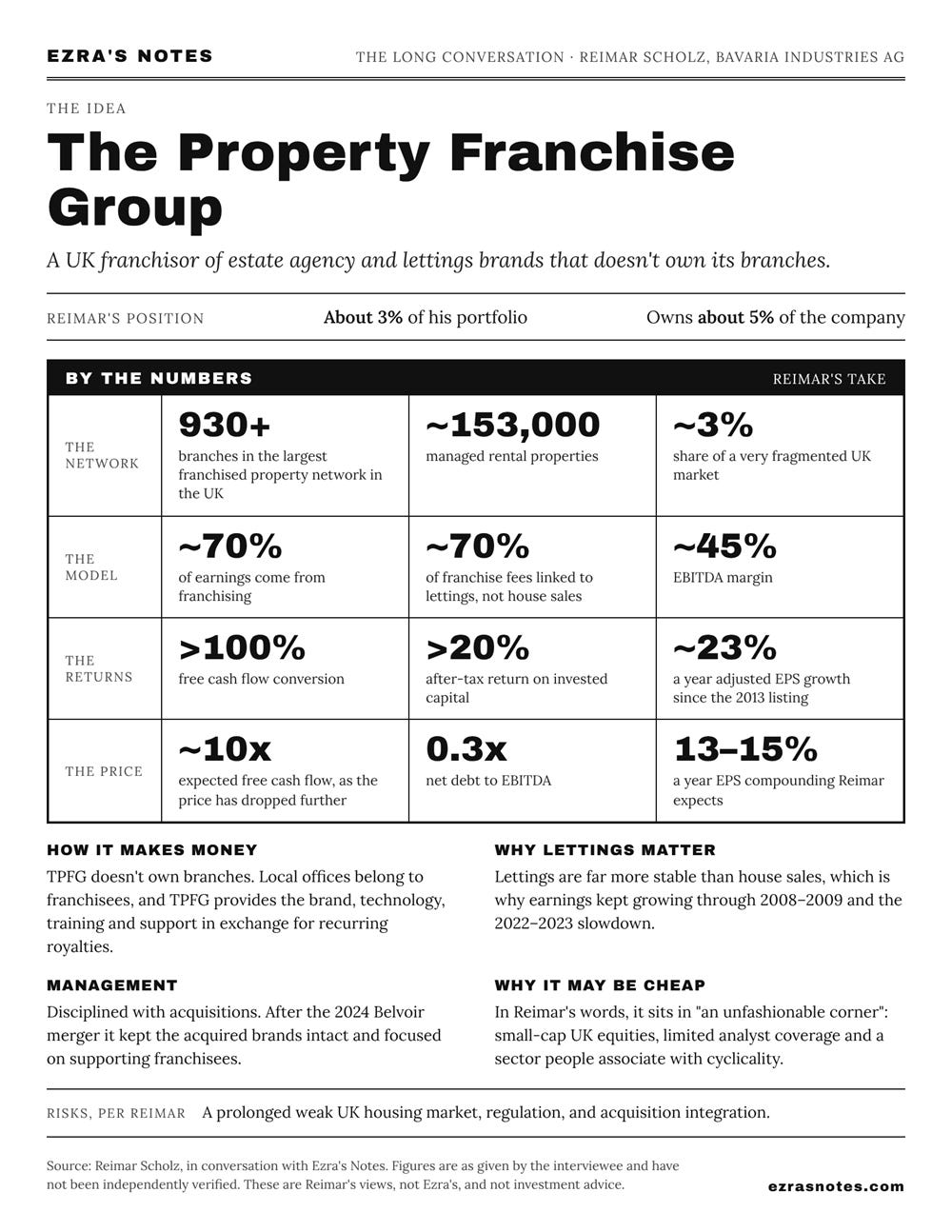
One we recently added to is The Property Franchise Group (TPFG), a UK franchisor of estate agency and lettings brands. We hold about 3% of our portfolio in it and own 5% of the company.
TPFG doesn’t own branches. Local offices belong to franchisees, and TPFG provides brand, technology, training and support in exchange for recurring royalties. It runs the largest franchised property network in the UK, with more than 930 branches and roughly 153,000 managed rental properties, yet it still holds only about 3% of a very fragmented market. Roughly 70% of its earnings come from franchising, and around 70% of those fees are linked to lettings rather than house sales. Lettings are far more stable, which is why earnings kept growing through 2008–2009 and the 2022–2023 slowdown.
The economics are strong: EBITDA margins of about 45%, free cash flow conversion above 100%, and after-tax returns on invested capital above 20%. Since its 2013 listing, adjusted earnings per share have compounded at around 23% a year. Management has also been disciplined. It kept acquired brands intact after the 2024 Belvoir merger and focused on supporting franchisees.
The stock trades at about 10x expected free cash flow, as the price has dropped further, with net debt of only 0.3x EBITDA. We think EPS can compound at 13–15% a year. The risks are a prolonged weak UK housing market, regulation and acquisition integration. The opportunity exists, I think, because it sits in an unfashionable corner: small-cap UK equities, limited analyst coverage and a sector people associate with cyclicality.
How do you think about concentration versus diversification? And how do you decide when to sell?
Since we invest in developing countries and very exotic markets we cannot concentrate enough as hard as we try. And since our philosophy is to average in and build positions slowly we always have a portfolio of ideas we are testing.
Our biggest 5 positions are more conventional bets and make out roughly a third of our equity portfolio and a quarter of our NAV - as we always hold a quarter or so of cash and gold as counterbalance to our more risky equity bets.
Name a couple of books or podcasts you’ve come across recently that have made you a better investor.
The first is Superforecasting by Philip Tetlock and Dan Gardner, built on the Good Judgment Project, which showed that ordinary people can outperform intelligence analysts.
Superforecasters don’t treat predictions as yes-or-no events but as probabilities. Instead of saying “this company will turn around,” they say 65% and keep updating that number as new information arrives. They also break a big question into smaller parts, separating what they can know about the specific case (the inside view) from general base rates (the outside view).
What I value most is their humility. They keep scorecards of past predictions and treat mistakes as data to calibrate their thinking, not as character flaws. And they combine many perspectives instead of relying on one grand narrative.
The second is Andy Grove’s work, mainly High Output Management and Only the Paranoid Survive. Grove treated management as an engineering discipline. A manager’s output is the output of the units under their influence, so the job is finding the activities with the highest leverage per unit of time.
His idea of task-relevant maturity says there is no single best way to manage: the style has to fit the person’s maturity for that specific task.
He also focused on strategic inflection points, when the old way of doing business dies and survival depends on recognizing the shift early, and he built a culture of constructive confrontation, where data beats hierarchy.
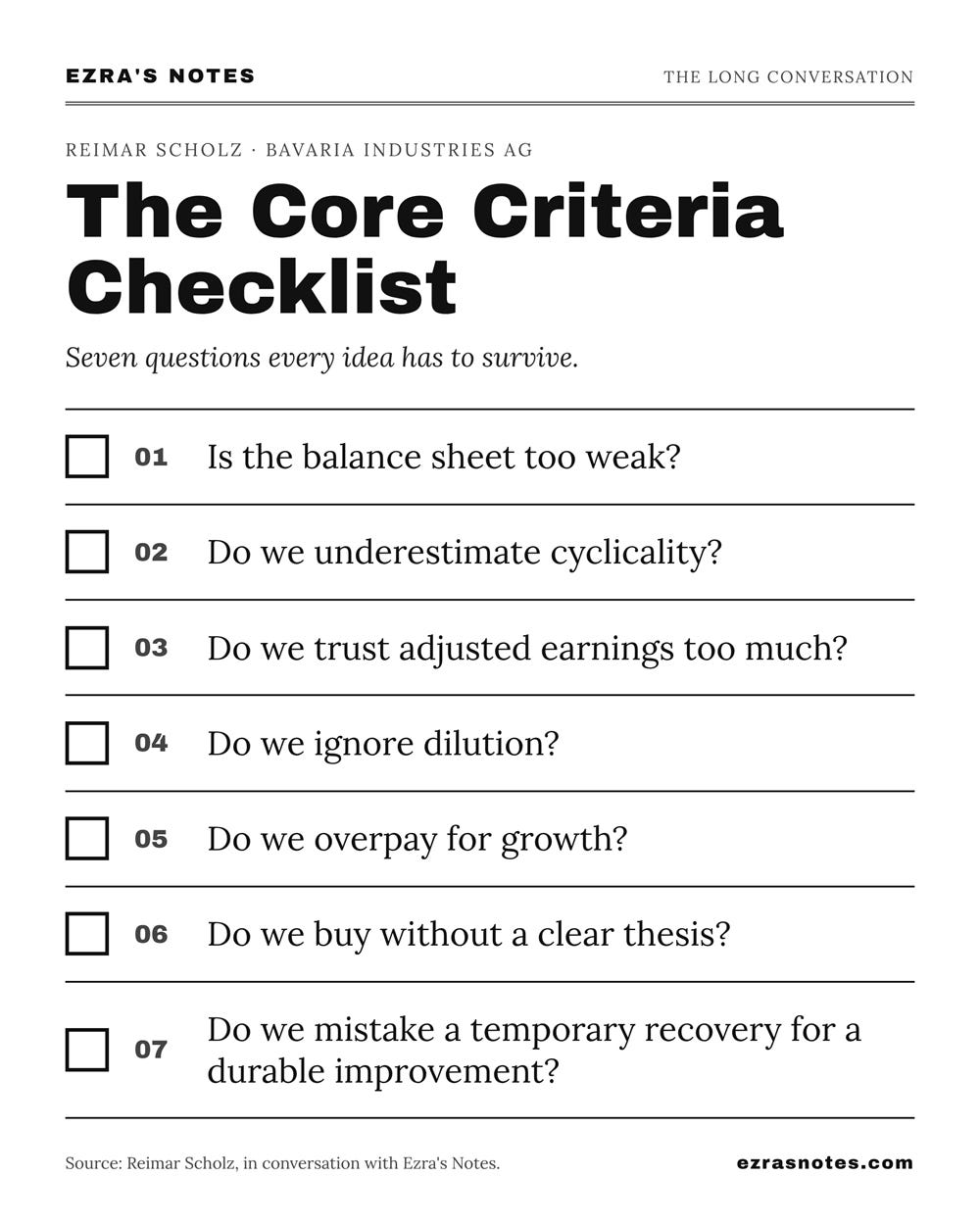
Share your core criteria checklist: the handful of non-negotiables every investment idea has to pass before you’ll consider it.
Is the balance sheet too weak?
Do we underestimate cyclicality?
Do we trust adjusted earnings too much?
Do we ignore dilution?
Do we overpay for growth?
Do we buy without a clear thesis?
Do we mistake a temporary recovery for a durable improvement?
If you could leave one piece of advice for other investors reading this — something you wish someone had told you earlier — what would it be?
Buying a stock is like buying a used car, always look for a snag and who is the fool in the transaction. Only buy if you identified a fool, if not put it into the too difficult basket (like most ideas).
Idea Snapshot
Reimar’s Core Criteria Checklist