



When an insured car gets wrecked or flooded and isn't worth fixing, the insurer has to sell it. Often it sends it to Copart (CPRT).
CPRT started in 1982 with a single yard in Vallejo, California. Today it has 286 facilities in 11 countries, where it stores those cars until someone buys them in its online auctions.
It's one of the most profitable businesses I know. In fiscal 2026 it earned 28.5% on the capital it needs to operate.
But that same year something happened that hadn't happened in years: it spent $1,633 million buying back its own stock.
A company that earns 28.5% on its capital should want to put every dollar back into the business. When it starts handing money back, it's worth asking why. That's what today's calculator is for.
This is the seventh post in a series of 13 on tools.ezrasnotes.com, the site of value investing calculators I built from my Excel templates. It's free, there's no account, and nothing you type leaves your browser. I've already run EPV on H&R Block, Greenwald's moat test on Hershey, Penman's model on AutoZone, Graham's formulas on Snap-on and Mauboussin's FCF on ServiceNow.
In the EPV post I promised to come back to Copart. Here it is.
This series runs one post a weekday. If you'd rather skip it, click "unsubscribe" at the bottom of this email and turn off only the Tools section. You'll keep getting everything else.
What the calculator measures
The calculator measures three things:
Return on Invested Capital (ROIC): how much the business earns on the capital it already has. It's operating profit after tax (known as NOPAT), divided by invested capital at the start of the year.
Return on Incremental Invested Capital (ROIIC): how much it earns on new capital. It's how much NOPAT grew, divided by how much capital grew a year earlier, because what you invest this year earns its profit the next.
The reinvestment rate (RR): how much of what the company earns goes back into the business, through capex, acquisitions and working capital, minus depreciation.
Together they tell you how fast a company can grow without borrowing or issuing shares. The RR times ROIC is the growth those returns can pay for.
ROIC and the RR follow Aswath Damodaran's definitions at NYU Stern. ROIIC, the one-year lag and the cash rule follow Michael Mauboussin and Dan Callahan.
Which companies it works for
It works for companies whose capital sits on the balance sheet: manufacturers, retailers, distributors, consumer brands and most services.
It works badly in three cases:
Banks and insurers, because debt is their raw material and invested capital means something else.
Companies built on R&D or marketing, because the accounting expenses that investment. Capital comes out too small and ROIC too high.
Serial acquirers after big write-downs, because impairments shrink capital and make returns look better than the deals were.
CPRT is exactly the case it's built for: almost all its capital is land, yards and cash, and it grows mostly by building its own yards.
The inputs
Figures come from Copart's 10-Ks for 2020 to 2026, in thousands of dollars. Its fiscal year ends July 31.
The calculator asks for seven years, oldest first. From the income statement: revenue and operating income. From the cash flow (CF) statement: capex, acquisitions, depreciation and the change in working capital. From the balance sheet: debt with leases, minority interest, shareholders' equity, cash and goodwill.
There were three judgment calls.
Taxes. Copart's effective rate was 19.3% in 2026 and 18.3% in 2025. I used 21%, the US federal rate, which is higher and therefore more conservative.
Operating cash. The calculator asks how much cash the business needs to operate, as a share of revenue. Anything above that is excess and comes out of invested capital. I left the 2% the page suggests. With CPRT, this call matters more than with almost any other company, and I'll explain why below.
Cost of capital. I used 8%, the same as with AutoZone. Here it's only for comparison.
The result
The company earned 28.5% on its capital in 2026, and 32.6% on average over the last 5 years. That's almost 4x the 8% I asked of it.
The business is excellent. But the year-by-year numbers tell another story:
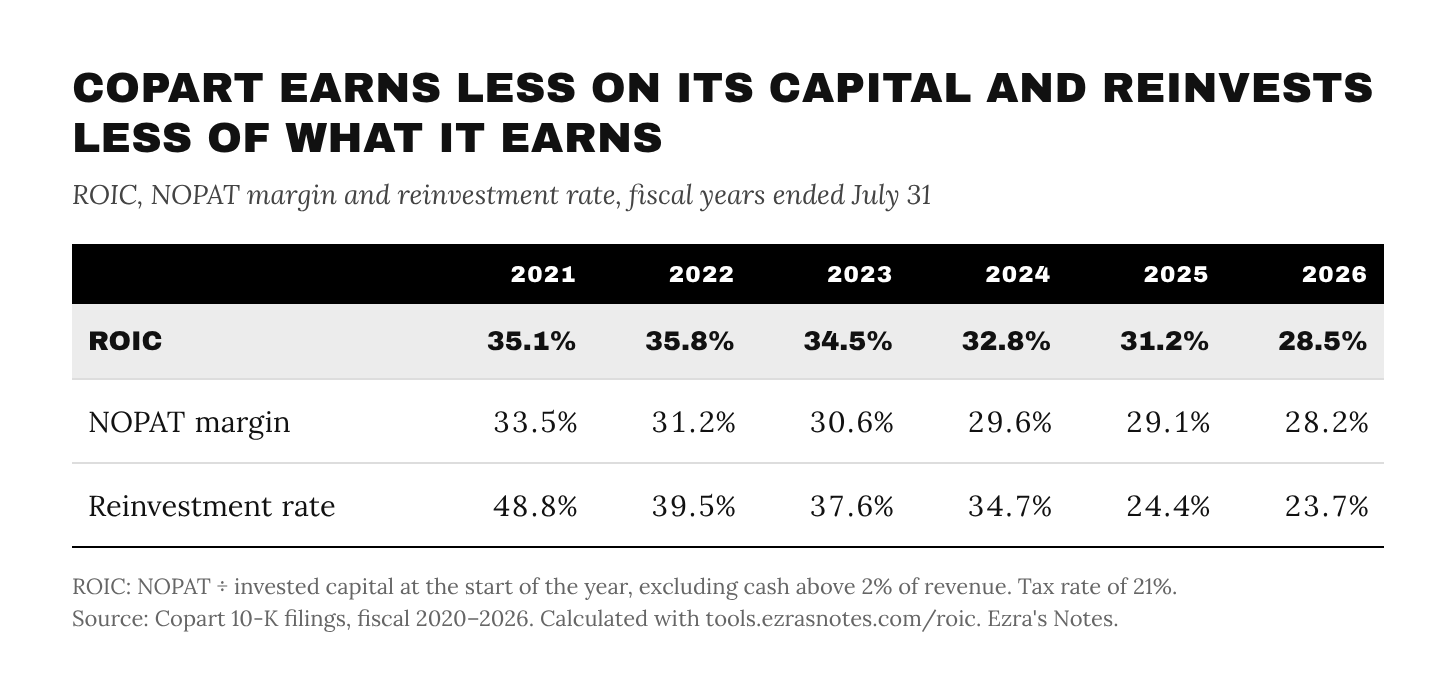
ROIC has been falling for five years, and almost all of it comes from the margin. Capital turnover barely moved.
And new capital earns less than old capital. Over the last 5 years, ROIIC was 20.2%. Over the last 3, 11.1%. That's still more than 8%, but each new dollar produces less than the one before.
At the same time, CPRT reinvests less and less. In 2021 it put almost half of what it earned back into the business. In 2026, less than a quarter.
The calculator pulls it all together in two numbers. Given what it reinvested and what it earned over 5 years, Copart could have grown 10.3% a year. Its NOPAT grew 7.8%. The gap, 2.4 points, means the reinvestment hasn't shown up in profit yet, or it earned less than the average.
In 2026 NOPAT fell 2.6%, on flat revenue. And that year the company went back to buying its own stock.
The importance of cash
One number explains why the cash rule matters so much here.
At the end of fiscal 2026, Copart had $4,490 million in cash and investments. Its shareholders' equity was $9,097 million. Almost half of shareholders' capital was sitting in the bank.
That money earns interest, $182 million in 2026, but it doesn't come from the business. That's why the calculator takes it out: at 2% of revenue, the business needs about $93 million to operate, and the rest goes out as excess. Invested capital ends up at $4,806 million.
If you didn't take it out, ROIC for 2026 would be around 14%. Half.
Both figures are true. The business earns 28.5% on what it needs to operate. Shareholders earn a lot less on everything they have invested, because half of it is cash. The 2026 buybacks are one way to close that gap.
What the calculator can't see
Whether ROIC will last. A high ROIC draws competition. In Mauboussin and Callahan's data from 1990 to 2022, fewer than half of the companies in the top fifth by ROIC were still there 3 years later.
Whether there will be room to reinvest. A company can earn very high returns and still have little room to put more capital to work. The calculator shows you what happened. How many new yards CPRT can open at good returns is another question.
What ROIIC is. It isn't a true return, and you can't compare it directly with ROIC. When it's above the cost of capital it overstates the economic return, and when it's below it understates it. That's why the page tells you to read the 3- and 5-year figures.
Final thoughts
Good businesses run into two problems over their lifetimes. Early on, they don't have enough money for everything they want to do. Later, they have more money than they can use well.
Copart seems to be entering the second stage. It still earns more than 28% on its capital, but each new dollar earns less, it reinvests a shrinking share of what it makes, and it has started handing the rest back.
None of the three measures tells that story on its own. Together, they do.
Try it yourself
The calculator is here: tools.ezrasnotes.com/roic
And here's my Copart case, with every field filled in.
Try two things. Raise operating cash from 2% to 50% of revenue and watch what happens to ROIC. Then set it back to 2% and lower the tax rate to 19%, what CPRT actually paid.
Once you have your own calculation, you can save it with the link or download it as a PDF or CSV. And if you'd like me to see it, use "Send to Ezra" at the bottom of the page. I read every one that comes in and, with your OK, I'll share some with the community.
If you were Copart, what would you do with $4,490 million in the bank? Tell me in the comments.
And if you liked this post, share the love!
DISCLAIMER: This post is not investment advice.