


For fourteen straight years, from 1973 to 1986, Walmart WMT 0.00%↑ burned cash. Free cash flow (FCF) came in negative every single year. Shareholders still earned 33% a year, three times the S&P 500, because the capital Walmart kept pouring back into the business earned an average of 18%.1
Ask Michael Mauboussin and Dan Callahan whether negative FCF is good or bad, and they answer in two words: “It depends.”2
Keep Walmart in mind. In its last fiscal year it took in $713.2 billion, every grocery cart and flat-screen TV bought by 280 million weekly shoppers across more than 10,900 stores.3 This year, four companies (Alphabet GOOG 0.00%↑ , Amazon AMZN 0.00%↑ , Meta META 0.00%↑ and Microsoft MSFT 0.00%↑ ) plan to spend close to $800 billion on chips, servers and data centers.4 That’s more than all of Walmart’s sales. It works out to about $2.2 billion a day, Sundays included.
The cash is already thinning. By Mauboussin and Callahan’s count, those four plus Oracle ORCL 0.00%↑ produced about $35 billion of FCF over the four quarters to mid-2026. Two years earlier, the figure was $170 billion.5
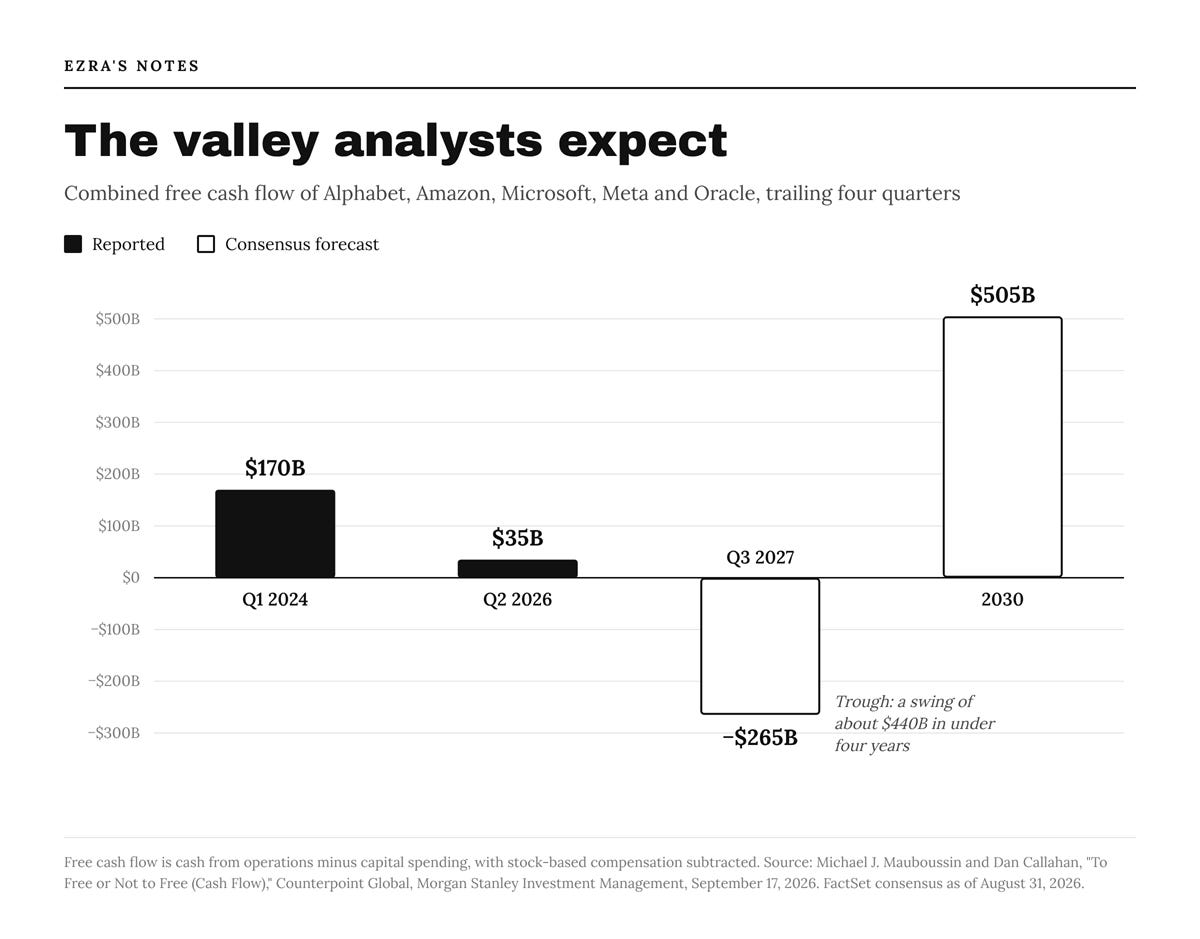
Two managers I’ve followed for years read those numbers through the same equation and landed on opposite sides. David Rolfe and his team at Wedgewood Partners bought more Microsoft, Amazon and Meta in the second quarter. Are the hyperscalers still magnificent? “We certainly think so and have increased our weightings accordingly.”6 Fred Liu at Hayden Capital used the same math to argue that the returns everyone is projecting may not hold.7
I don’t know who’s right. Neither do they, yet. What I can share is how I’m working through it: five questions that separate their views, the numbers behind each answer, and the signals that should settle the debate over the next 12 to 24 months.
One equation, two readings
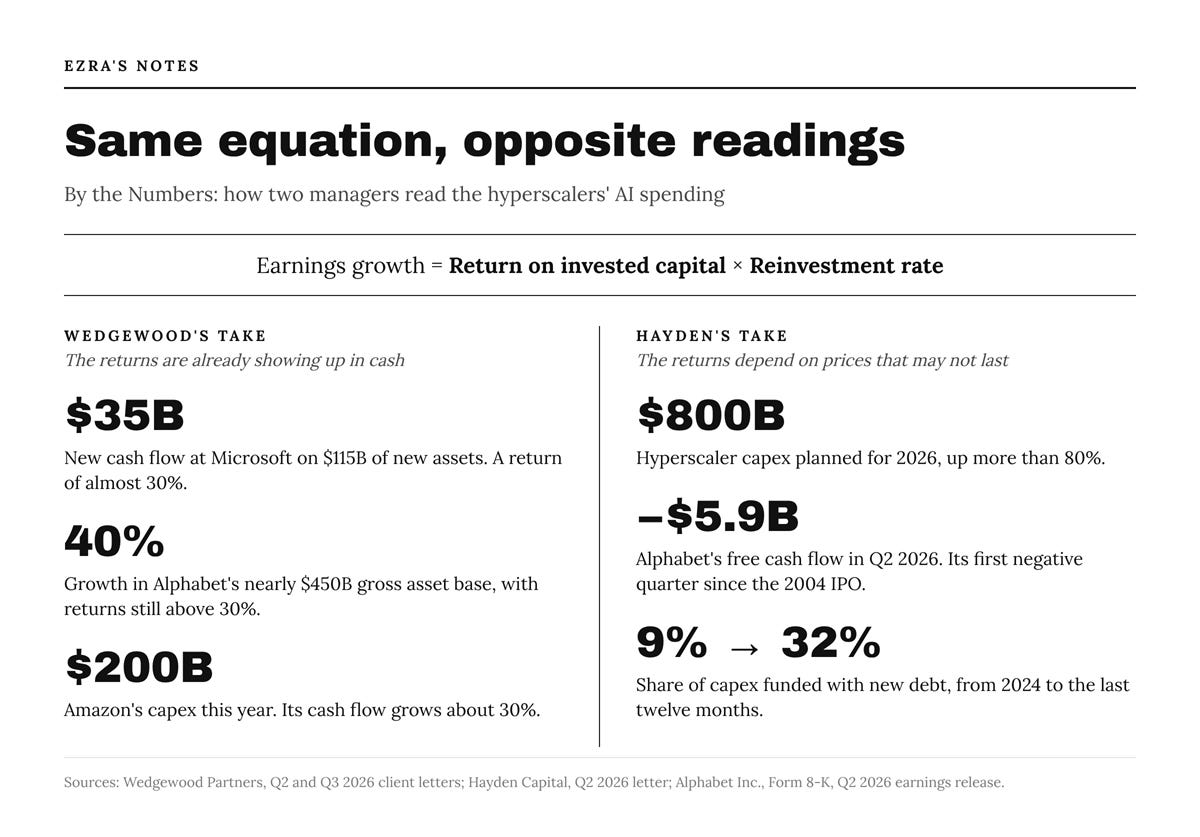
Liu writes it in a single line: earnings growth equals return on invested capital (ROIC) times the reinvestment rate.⁸ Earn 20% on your capital, plow back half your profits, and you grow 10% a year. Plow back everything and you grow 20%, provided the 20% holds.
That condition is the whole fight. Growth creates value only while the return on the new dollar beats the cost of capital. Below that line, growth destroys value, however good the revenue chart looks.⁹
Both managers agree the hyperscalers are pushing reinvestment close to 100%. They part ways on what all that new capital will earn, and for how long.
1. Is the return showing up in cash?
This is Wedgewood’s home turf. Its team skips accounting earnings and measures something harder to dress up: new cash flow against new gross assets.
Over two years, Microsoft added an average of $100 billion in assets and $27 billion in incremental cash flow, a return near 30%.¹⁰ A quarter later the numbers were $115 billion and $35 billion. Still almost 30%.¹¹ Amazon is spending about $200 billion this year, enough to enlarge its asset base by an estimated 28%, while its cash flow grows around 30%. Alphabet grew a gross asset base of nearly $450 billion by 40% and kept returns above 30%.¹²
Fred Liu looks at the same quarter and sees the bill. Alphabet spent $44.9 billion on property and equipment in the second quarter, against $39.1 billion of cash from operations. FCF: minus $5.9 billion.¹³ By Liu’s count, it was Alphabet’s first negative quarter since its 2004 IPO.¹⁴
Both readings fit the facts. The tiebreaker is Wedgewood’s own yardstick, tracked quarter after quarter: how many dollars of new cash flow each dollar of new assets produces. Mauboussin’s version is ROIIC, the return on incremental invested capital. If after-tax operating profit rises from $100 to $140 on $200 of new investment, ROIIC is 20%.¹⁵
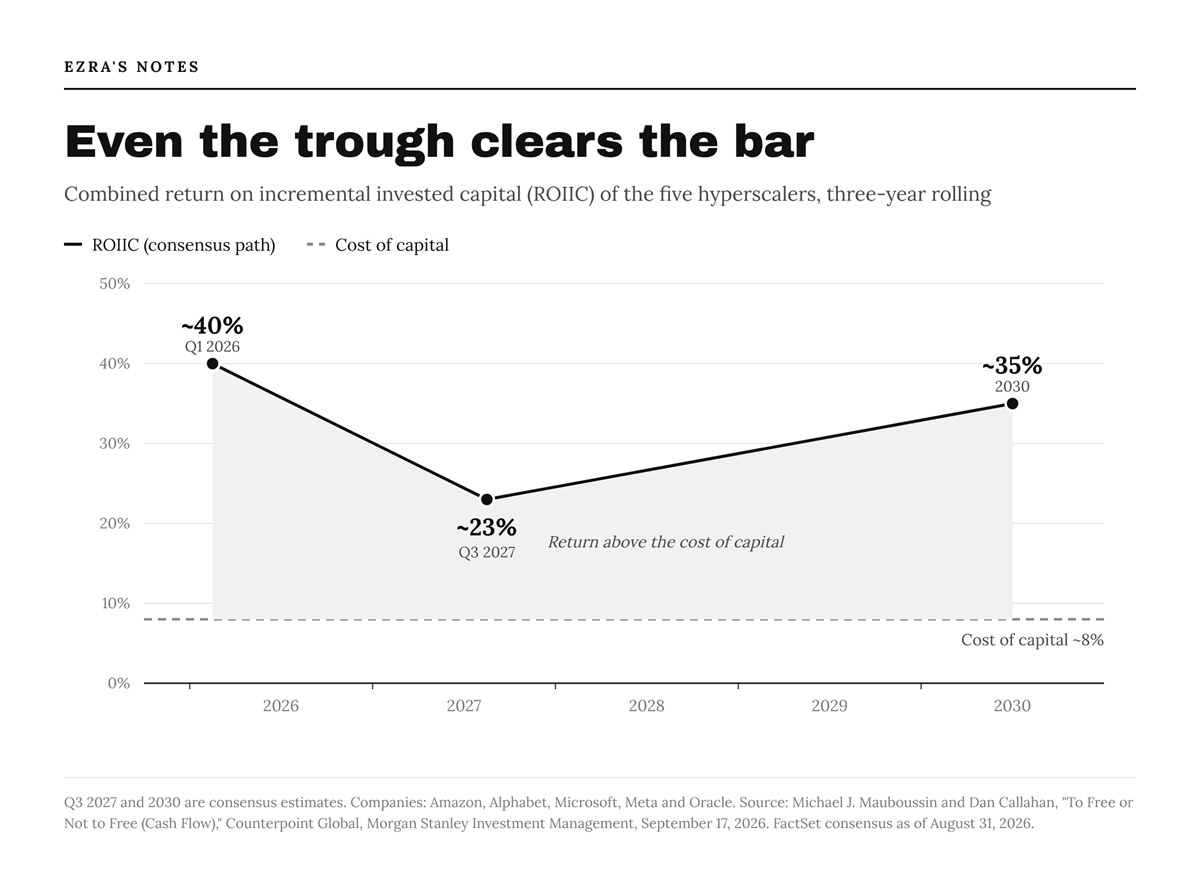
On consensus forecasts, the four plus Oracle hit a combined ROIIC near 40% in early 2026, against a cost of capital of about 8%. Analysts see it bottoming around 23% in the third quarter of 2027 and recovering to near 35% by 2030.¹⁶ Even the trough clears the bar. What I want to know is whether the trough lands where consensus puts it.
2. Durable return, or scarcity price?
Now Fred is on his home turf. Sell-side models that show 25% to 50% returns on AI projects run off today’s spot price for compute, and new supply could break that price. Tencent said it could resell compute it had ordered months earlier at a markup of more than 30%, which looks more like hoarding than end demand. As SK Hynix, Samsung and CXMT bring capacity online, those premiums should shrink.¹⁷
His line: “The sustainability of ROIC matters more to a stock price, than its absolute level.”¹⁸
The base rates side with the worry. Mauboussin and Callahan found that the gap between the top and bottom fifths of companies by ROIC narrows from 35 points to 15 within five years. In technology, ROIC persistence over five years is weak, a correlation of 0.25. And 15% of top-quintile companies drop to the bottom quintile within three years, where shareholders lose about 11% a year.¹⁹
Wedgewood’s reply is cost. Alphabet says its in-house TPU chips cut the cost of serving Gemini by almost 80%.²⁰ A company that builds capacity cheaper than anyone can rent it will be the last to feel falling compute prices.
That’s why I’d track ROIIC company by company. Consensus already expects Meta’s to fall from about 70% to 16% by late 2027.²¹ An average can hide a weak member for years.
3. Who’s paying?
A return earned on internal cash and the same return earned on borrowed money carry different risks.
Fred Liu tracks the shift. Debt went from funding about 9% of hyperscaler capex in 2024 to roughly 32% over the last twelve months.²² Equity joined in June, when Alphabet launched an $80 billion stock sale, upsized to $84.75 billion at pricing, with $10 billion of it sold to Berkshire Hathaway.²³ Meta’s Q3 report, out on October 21, shows the same pattern: negative FCF of $2.12 billion, no buybacks so far in 2026, and long-term debt up from $58.7 billion to $80.9 billion since December.²⁴
Daniel Gladiš at Vltava describes the broader move from buying back stock to issuing it.²⁵ GMO’s Ben Inker and John Pease put a price on it. For the first time in twenty years outside the financial crisis, issuance exceeds buybacks, and historically every 1% increase in equity supply has cut total market value by about 4% over the following year.²⁶
Wedgewood points to an offset most investors skip: the hyperscalers’ stakes in AI labs. Alphabet owns about 14% of Anthropic. Microsoft’s OpenAI stake and Amazon’s Anthropic stake are each worth $100 billion or more, by Wedgewood’s estimates. Meta’s AMD warrants are worth close to $90 billion, about nine times its extra memory bill for 2026. Alphabet’s SpaceX and Anthropic gains alone, about $150 billion if realized, could pay for several years of extra memory-driven capex.²⁷ None of it shows up in reported earnings.
The question I’d ask about that hedge is simple: what is it worth on the day you need it? Those stakes carry private marks set by the same AI cycle. If the cycle turns, they shrink just as the capex bill comes due. Whether any of them turns into cash before then is one of the cleaner signals in this debate.
4. Are today’s earnings normal?
This one reaches past the hyperscalers to the earnings of the whole market.
Gladiš describes a timing gap. When a hyperscaler buys a server, the supplier books the sale today. The buyer spreads the cost as depreciation over the next several years. The cycle lifts profits now and mails the bill later. S&P 500 net margins sit near 15%, against a historical norm in the single digits. Record profits aren’t the issue, he writes: “The problem is mistaking them for the norm.”²⁸
Jacobo Arteaga and Javier López Bernardo at BrightGate Capital reach the same place through Michał Kalecki’s profit equation, in which one company’s investment is another company’s profit. During the 1998–2001 telecom and internet buildout, S&P 500 operating earnings climbed 43% from late 1998 to mid-2000, then fell almost 40% in under a year. “It is telling that the bubble burst precisely at the peak of earnings.”²⁹
Bill Nygren at Oakmark asks the question at the supplier level. Micron’s MU 0.00%↑ projected 2027 operating margin is above 80%, while its history runs in the high single digits. Oakmark stayed away from AI hardware because it doubted those earnings would last, and it paid for that. AI-related names produced more than half of the Russell value index’s performance this year, and Nygren admits Oakmark missed them.³⁰
Nvidia NVDA 0.00%↑ shows how slippery “normal” gets. Bill puts it at about 11x consensus 2028 earnings.³¹ Liu puts it at about 21x current earnings, below Costco’s COST 0.00%↑ 43.³² Neither calls it expensive. Read together, they’re saying the multiple is only cheap if the earnings are real.
Even Wedgewood, the bull in this story, keeps its distance from chipmakers. It warns that semiconductors are cyclical and that peak earnings deserve trough valuations.³³ Its optimism is about the companies buying AI capacity. The sellers are another matter.
5. What if consensus is wrong?
Every reassuring number in question 1 is an analyst forecast. Mauboussin flags it himself: estimates grow less reliable the further out they reach.³⁴
The most revealing table in his paper tracks revisions from August 2025 to August 2026. Analysts raised their 2027 capex forecasts by $210 billion at Alphabet, $142 billion at Amazon, $116 billion at Microsoft and $86 billion at Meta. They raised 2027 operating income by $52 billion, $22 billion, $15 billion and $2 billion. Nvidia and Micron, the suppliers, got $231 billion and $192 billion of upgrades.³⁵
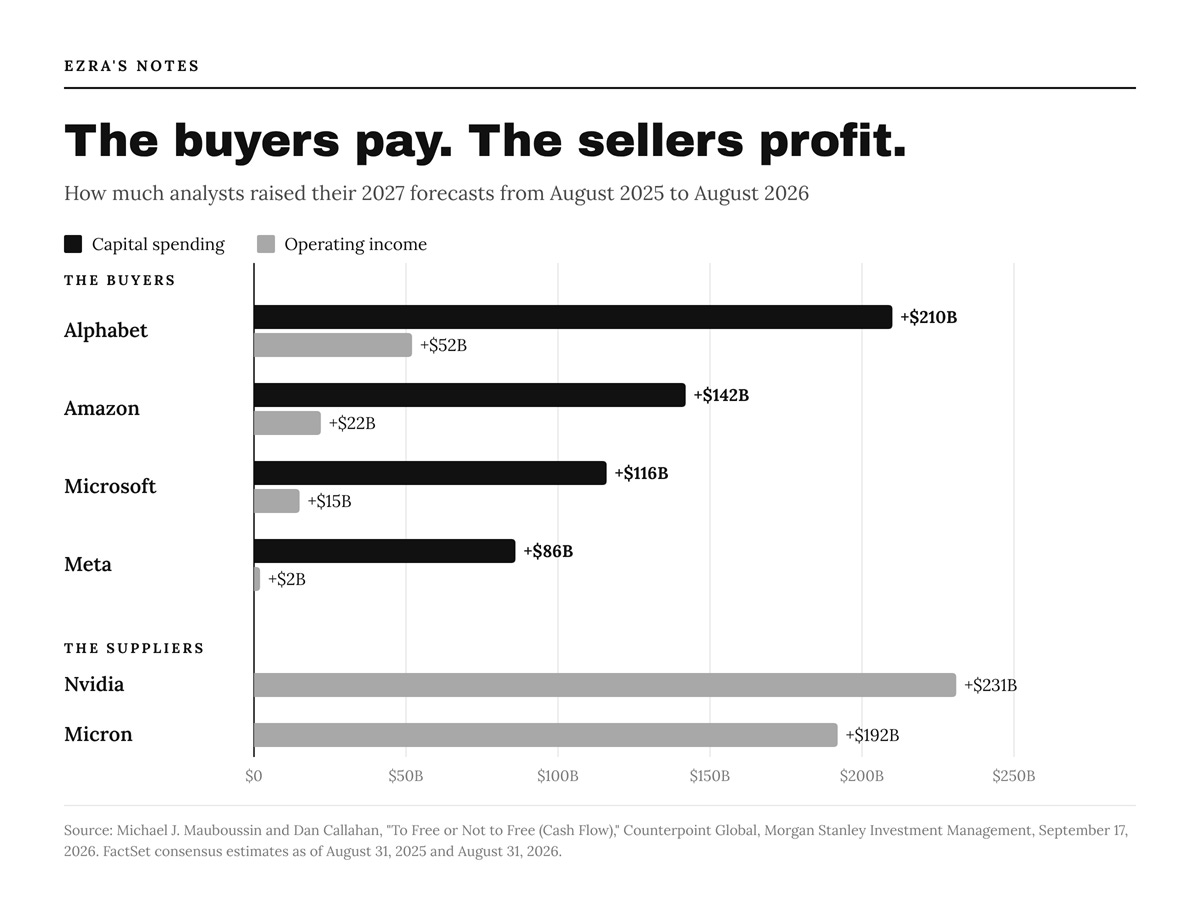
So far, the buyers absorb the capex and the sellers book the profit.
Small shifts in that picture count for more than they seem. In Mauboussin’s math, if expected growth slips from 10% to 7%, next year’s earnings drop only 2.7%, but the justified P/E falls 22.9%.³⁶ Rates pile on. On October 5 the 10-year Treasury yield closed at 5.31%,³⁷ and the Nasdaq 100 hit a record the same day. Long-duration assets should feel a higher cost of capital, Wedgewood notes, “yet very few AI stocks are punished as such.”³⁸
Oakmark, the fund that missed the run, also spells out the record any skeptic has to beat. For the largest tech companies, “earnings growth not only failed to regress—it accelerated.”³⁹ Their 2026 consensus earnings are about twice what analysts expected back in 2019.
What to watch for through 2027
New cash flow per dollar of new assets: Wedgewood’s own measure. If Microsoft and Amazon keep converting near 30%, the bull case holds.
The ROIIC trough: consensus expects about 23% in the Q3 of 2027, against an 8% cost of capital.⁴¹ A deeper or later trough favors Fred Liu.
Operating income revisions vs. capex revisions: if earnings forecasts don’t catch up, the buyers are funding the suppliers’ record year.
Compute and token prices: falling prices with steady volumes would test Liu’s scarcity argument head-on.
Debt share of capex funding and net share issuance: both rising favors the skeptics.
Depreciation against revenue at the hyperscalers: the deferred bill from question 4 shows up here first.
June 12, 2027: the last SpaceX SPCX 0.00%↑ lockup expires, freeing roughly $2 trillion of stock, with Anthropic and OpenAI listings possibly landing in the same window.⁴²
Meta: consensus already expects its incremental returns to fall the furthest, and its Q3 brought negative FCF and more debt. If the bear case is right, it should show there first.
Picture an investor in 1980 holding Walmart’s cash flow statement. Seven years of red ink behind it, six more still to come. What mattered was never the cash flow. It was what each dollar would earn later. Wedgewood and Hayden are asking that question about $800 billion. By 2028 we should know which kind of red ink this was.
DISCLAIMER: This post summarizes the views of the investment managers and analysts cited. Their opinions are their own, not those of Ezra's Notes or its author. Figures come from their published letters and research and from company filings, as listed in the notes; consensus estimates can change. I have no position in any of the companies mentioned. This post is for educational and informational purposes only. It is not investment advice or a recommendation to buy or sell any security. Do your own research or consult an advisor before making any investment decision.
Notes
Michael J. Mauboussin and Dan Callahan, “To Free or Not to Free (Cash Flow),” Consilient Observer, Counterpoint Global, Morgan Stanley Investment Management, September 17, 2026. Consensus figures are FactSet estimates as of August 31, 2026, and cover Amazon, Alphabet, Microsoft, Meta and Oracle. https://www.morganstanley.com/content/dam/im/assets/publication/thought-leadership/consilient-observer/article_tofreeornottofree_ltr.pdf
Ibid.
Walmart Inc., Form 10-K for the fiscal year ended January 31, 2026 (total revenues of $713.2 billion; approximately 280 million customers a week in more than 10,900 stores). https://www.sec.gov/Archives/edgar/data/104169/000010416926000055/wmt-20260131.htm
Hayden Capital, Quarterly Letter Q2 2026, August 27, 2026, Fred Liu. https://content.haydencapital.com/Hayden-Capital-Quarterly-Letter-2026-Q2.pdf
Mauboussin and Callahan, “To Free or Not to Free (Cash Flow).”
Wedgewood Partners, Second Quarter 2026 Client Letter, “Are Hyperscalers Still Magnificent?”, July 2026, David Rolfe, Michael Quigley and Christopher Jersan. https://wedgewoodpartners.com/wp-content/uploads/2026/07/Wedgewood_2Q2026_Hyperscalers.pdf
Hayden Capital, Quarterly Letter Q2 2026.
Ibid.
Michael J. Mauboussin and Dan Callahan, “The Math of Value and Growth: Growth, Return on Capital, and the Discount Rate,” Consilient Observer, June 9, 2020. https://www.morganstanley.com/im/publication/insights/articles/article_themathofvalueandgrowth.pdf
Wedgewood Partners, Second Quarter 2026 Client Letter.
Wedgewood Partners, Third Quarter 2026 Client Letter, “Bad Moon Rising,” October 2026, David Rolfe, Michael Quigley and Christopher Jersan. https://wedgewoodpartners.com/wp-content/uploads/2026/10/Wedgewood-Partners-Third-Quarter-2026-Client-Letter-Bad-Moon-Rising-2.pdf
Wedgewood Partners, Second Quarter 2026 Client Letter.
Alphabet Inc., Form 8-K, Exhibit 99.1, Q2 2026 earnings release, July 2026 (net cash provided by operating activities $39,069 million; purchases of property and equipment $44,924 million; free cash flow $(5,855) million). https://www.sec.gov/Archives/edgar/data/0001652044/000165204426000066/googexhibit991q22026.htm
Hayden Capital, Quarterly Letter Q2 2026.
Mauboussin and Callahan, “To Free or Not to Free (Cash Flow).”
Ibid.
Hayden Capital, Quarterly Letter Q2 2026.
Ibid.
Michael J. Mauboussin and Dan Callahan, “ROIC and the Investment Process: ROICs, How They Change, and Shareholder Returns,” Consilient Observer, June 6, 2023. https://www.morganstanley.com/im/publication/insights/articles/article_roicandtheinvestmentprocess.pdf
Wedgewood Partners, Second Quarter 2026 Client Letter.
Mauboussin and Callahan, “To Free or Not to Free (Cash Flow).”
Hayden Capital, Quarterly Letter Q2 2026.
Alphabet Inc., Form 8-K, Exhibit 99.1, “Alphabet Announces Proposed $80 Billion Equity Capital Raise,” June 1, 2026. https://www.sec.gov/Archives/edgar/data/0001652044/000119312526257724/d83560dex991.htm. Upsizing to $84.75 billion at pricing: Cleary Gottlieb, “Alphabet in $80 Billion Equity Offerings,” June 4, 2026. https://www.clearygottlieb.com/news-and-insights/news-listing/alphabet-in-80-billion-equity-offerings-jun-2026
Meta Platforms, Inc., Form 8-K, Exhibit 99.1, Q3 2026 earnings release, October 21, 2026 (free cash flow of negative $2.12 billion; long-term debt of $80.92 billion at September 30, 2026, against $58.74 billion at December 31, 2025). https://www.sec.gov/Archives/edgar/data/0001326801/000162828026066700/meta-09302026xexhibit991.htm
Vltava Fund SICAV, Letter to Shareholders 3/2026, “Tadej Pogačar and investing in stocks,” October 2026, Daniel Gladiš. https://www.vltavafund.com/dopisy-akcionarum/tadej
Ben Inker and John Pease, “A Catalyst for the AI Bubble Break,” GMO Quarterly Letter, 3Q 2026. https://www.gmo.com/americas/research-library/a-catalyst-for-the-ai-bubble-break_gmoquarterlyletter/
Wedgewood Partners, Second Quarter 2026 Client Letter.
Vltava Fund, Letter to Shareholders 3/2026.
BrightGate Capital SGIIC, Interim Letter to BrightGate Global Income co-investors, first half of 2026, Madrid, July 13, 2026, Jacobo Arteaga Fierro and Javier López Bernardo. https://www.brightgatecapital.com/documentacion/brightgate/global-income/cartas/2026-H1-ENG.pdf
Harris | Oakmark, “A Conversation with Shareholders,” U.S. Equity Market Commentary 3Q26, September 30, 2026, Bill Nygren. https://oakmark.com/wp-content/uploads/sites/3/2026/10/A-conversation-with-shareholders_U.S.-equity-market-commentary_3Q26_vF.pdf
Ibid.
Hayden Capital, Quarterly Letter Q2 2026.
Wedgewood Partners, Second Quarter 2026 Client Letter.
Mauboussin and Callahan, “To Free or Not to Free (Cash Flow).”
Ibid.
Mauboussin and Callahan, “The Math of Value and Growth.”
U.S. Department of the Treasury, Daily Treasury Par Yield Curve Rates, October 2026. https://home.treasury.gov/resource-center/data-chart-center/interest-rates/TextView?type=daily_treasury_yield_curve&field_tdr_date_value_month=202610
Wedgewood Partners, Third Quarter 2026 Client Letter.
Harris | Oakmark, “A Conversation with Shareholders,” 3Q26.
Earnings dates from the companies’ announcements. Alphabet: “Alphabet Announces Date of Third Quarter 2026 Financial Results Conference Call” (October 28, 4:30 p.m. ET). https://abc.xyz/investor/news/news-details/2026/Alphabet-Announces-Date-of-Third-Quarter-2026-Financial-Results-Conference-Call-2026-8tpGZsLS6v/default.aspx. Microsoft: “Microsoft announces quarterly earnings release date” (October 28, after market close). https://finviz.com/news/400058/microsoft-announces-quarterly-earnings-release-date. Amazon: “Amazon will share its Q3 2026 earnings on October 29.” https://www.aboutamazon.com/md/news/company-news/amazon-earnings-q3-2026-report
Mauboussin and Callahan, “To Free or Not to Free (Cash Flow).”
Inker and Pease, “A Catalyst for the AI Bubble Break.”
Which reading do you find more convincing, Wedgewood's or Hayden's? And which signal on that list would change your mind? Tell me in the comments.
And if you liked this post, share the love!