Mauricio Heck passed on a company that replaces security guards with camera towers, because he couldn’t find its moat. The stock went on to multiply several times over. What that miss taught him is one of the lessons in this conversation.
A former Google employee turned full-time investor, Mauricio writes Polymath Investor . Here he also talks about how his approach has evolved, three areas on his radar, and the three criteria every idea has to pass.
Tell me about your background and how you got into investing.
I studied business at university and graduated in 2005. I always had an interest in investing, but my professional career initially took me into technology.
I worked at Google in the late 2000s, when the company was still doing things that were quite revolutionary at the time. I got a firsthand look at how a technology company could challenge established ways of doing business, not just through its products, but through its culture, hiring practices, employee benefits, and even things like the famous 20%-time policy, which encouraged employees to pursue their own projects.
Today, many of those practices are commonplace. Back then, they were unusual. That experience exposed me to a different way of thinking about organizations, and I eventually applied many of those lessons to companies I helped build and manage.
After Google, I became involved in several startups. One of the companies where I was a partner was eventually sold to a multinational, which gave me some capital and the freedom to think about what I wanted to do next.
Naturally, I started investing that capital, and somewhere along the way, I realized that investing was what I really wanted to do full-time.
There’s that old saying that if you love what you do, you’ll never work another day in your life. I think that’s roughly when I stopped working and started investing.
Of course, the transition wasn’t immediate. I did other things along the way, but I had made the decision that I wanted to dedicate the rest of my career to investing.
As for how I discovered value investing, I think almost every value investor remembers their first real encounter with Warren Buffett.
Interestingly, mine wasn’t through a book. It was through a video.
I must have come across it around 2001 or 2002. It was Buffett speaking to students at the University of Florida in 1998. I don’t even remember how I found it, but I remember being fascinated by the way he approached investing, business, and life in general.
I’d obviously heard of Buffett before, but that was probably my first meaningful exposure to his philosophy.
And I suppose that’s where the journey really began.
What’s your investment approach, and how has it evolved over time?
Investing isn’t a photograph. It’s a movie.
I think every investor’s approach evolves. I’d be surprised to find someone who’s been investing for 30 years and still approaches the market exactly as they did on day one.
That’s actually one of the things I love about investing. It’s a compounding journey. You’re constantly learning, adjusting, and hopefully getting a little better.
Investing isn’t a photograph. It’s a movie.
I’ve always gravitated toward fundamental, long-term investing. I was never particularly attracted to quantitative trading strategies or constantly moving in and out of positions. I like understanding businesses, how they make money, what makes them competitive, and what they might look like several years down the road.
Of course, that doesn’t mean every investment ends up being held for years. But that’s generally the mindset I bring to a new position.
As for how my approach has evolved, I sometimes think of it in terms of the hero’s journey, the archetype Joseph Campbell describes in The Hero with a Thousand Faces. The protagonist goes through different stages, encounters challenges, makes mistakes, and comes out changed by the experience.
Investors go through something similar.
Look at Buffett himself. He started with cigar butts before gradually moving toward higher-quality businesses.
Many value investors follow a similar trajectory. Early on, you’re fascinated by cheapness. You’re looking for something trading at a fraction of book value or an absurdly low earnings multiple. Over time, you begin to appreciate the value of a genuinely good business, even if it doesn’t look quite as cheap on traditional metrics.
But I don’t think there’s a universal destination. Different approaches work for different investors.
One thing I’ve learned is that your investment strategy needs to fit your particular circumstances and strengths. Your portfolio size matters. Your personality matters. Your knowledge, experience, and even your stage of life matter.
The strategy that makes sense for someone managing a small personal portfolio might not make sense for someone running billions of dollars.
Personally, I’ve been moving increasingly toward higher-quality businesses. But I don’t consider that the final stage of anything.
I’m still learning, and I expect my approach to keep evolving.
Tell me about one of your biggest investment mistakes, what happened, and what did you take away from it?
How much time do you have? I could probably fill several pages with those.
I think it’s useful to distinguish between errors of commission and errors of omission. The first are investments you made that turned out badly. The second are investments you should have made but didn’t.
Buffett has often argued that errors of omission can be the most expensive ones. And I think there’s a lot of truth to that.
One relatively recent example for me is Zedcor (CVE: ZDC).
It’s a company that provides mobile surveillance systems. Essentially, they install camera-equipped towers with their own power systems, connected to a centralized monitoring operation. They also use AI to detect potential threats and monitor large areas.
For many customers, these systems can replace traditional security guards, potentially offering better coverage at a lower cost.
The company has grown tremendously over the past few years, and we had the chance to meet with management early in that journey.
But I didn’t invest.
My concern was the moat, or rather, the apparent lack of one.
I kept asking myself: If this business model works so well, what’s stopping someone else from doing exactly the same thing?
I couldn’t identify a particularly strong competitive advantage that would prevent competitors from replicating the offering.
So I passed.
The stock subsequently went on to multiply several times over. I think it was close to a ten-bagger at one point, perhaps sevenfold after a pullback. I don’t remember the exact figures, but the point is that it became a very successful investment that I missed.
What did I learn?
I think I underestimated the importance of the opportunity ahead of the company relative to its existing competitive advantages.
When you’re operating in a market with an enormous amount of untapped demand, you don’t necessarily need an impregnable moat from day one.
Sometimes, execution matters more.
If a company is starting from a very small base, has a huge addressable market ahead of it, and can execute consistently, it may have years of growth before competition becomes the defining issue.
That doesn’t mean competitive advantages don’t matter. Of course they do. But I think I was putting too much weight on the company’s ability to defend its position and not enough on its ability to capture a market that was still largely undeveloped.
In other words, I was worried about how the company would protect its market share before fully appreciating how much market share there was left to capture.
That’s a lesson I’ll remember.
What are three ideas on your radar right now? Pick one and walk me through it.
I’m going to cheat a little here.
Rather than give you three specific companies, I’ll give you three areas I’m particularly interested in and explain why.
One thing I’ve always believed is that a company doesn’t exist in isolation. It’s constantly interacting with its environment.
The environment shapes the company, and the company, in turn, can shape its environment. You can’t really understand a business without understanding the forces acting on it.
That’s why I like looking for sectors with strong structural tailwinds.
If I’m going to invest in a company, I’d rather have the wind at my back than have to fight against it. It doesn’t guarantee success, of course, but I think it improves the odds.
The first area is prediction markets.
There’s a lot happening in this space, and I’m particularly interested in the structure of the opportunity from a public-market perspective.
One setup I like is when you have a powerful secular trend but very few publicly traded companies that give investors exposure to it.
Often, the leading businesses are still private. Meanwhile, institutional investors looking for exposure to the theme have only a handful of public vehicles available.
That imbalance can create interesting opportunities.
I’m not interested in buying something simply because it happens to be associated with a fashionable theme.
Naturally, the company still has to meet my investment criteria. I’m not interested in buying something simply because it happens to be associated with a fashionable theme.
But I find the combination of a strong underlying trend and limited public-market exposure particularly interesting.
The second area is the declining cost of compute.
I think the cost of computing power is going to fall dramatically over the coming years.
That raises a question I find fascinating: Which business models become possible when the cost of compute falls by an order of magnitude, or perhaps several?
What can companies do tomorrow that would be economically impossible today?
And which existing businesses stand to benefit disproportionately from that change?
There’s a tendency to focus on the companies supplying the computing infrastructure. But I’m equally interested in the businesses that will benefit from consuming much cheaper compute.
Sometimes the most interesting opportunities are not in the technology itself, but in what the technology suddenly makes economically viable.
The third area is software companies that may have been unfairly punished by the AI narrative.
There’s been a lot of discussion about the so-called SaaS apocalypse, the idea that AI will make traditional software businesses obsolete.
And there’s some truth to that. Certain businesses will absolutely be disrupted.
But the market doesn’t always distinguish between the companies that are genuinely vulnerable and those that have more durable competitive advantages.
When fear takes over, everything tends to get sold together.
That’s where I think opportunities may emerge.
I’m particularly interested in software companies whose competitive advantages extend beyond the complexity of the software itself.
Maybe they have strong network effects. Maybe they operate a two-sided marketplace. Maybe their value comes from something that can’t easily be replicated simply by writing code.
Because I do think software development costs are heading dramatically lower.
We’ve already seen tools that can reproduce increasingly sophisticated software functionality with remarkably little effort. That trend is only going to accelerate.
So if the cost of building software keeps approaching zero, what happens to the companies whose only real advantage was that their software was difficult or expensive to develop?
Conversely, what happens to companies whose real advantages lie elsewhere?
I think that distinction will become increasingly important, and I’m looking for opportunities where the market may be failing to make it.
How do you think about concentration versus diversification? And how do you decide when to sell?
I’ve written quite extensively about this in my newsletter because I think it’s a fascinating question.
To me, the right level of concentration is highly personal. Not personal in the sense of taste or preference, but in terms of your capabilities, your knowledge, and how well you understand the businesses you own.
I wrote an article exploring some of the intuitions behind portfolio construction, and one of the conclusions was fairly simple.
Imagine you had a group of companies that were effectively identical in all the characteristics that matter to you.
Same valuation, same expected returns, same competitive advantages, same management quality, same growth runway, same returns on capital. Everything.
Would you rather own just one of them or several?
My answer is that I’d rather own as many as I could responsibly follow and understand.
If their expected returns are identical, concentrating in one doesn’t necessarily improve your expected outcome. But it does expose you to more company-specific risk.
And as investors, we have to accept that the world is unpredictable.
A competitor emerges. A customer disappears. Management makes a mistake. Something happens that nobody anticipated.
Markets have a remarkable ability to teach humility.
So, all else being equal, I’d rather have several shots on goal than just one.
But there’s another force pulling in the opposite direction.
I wrote about this in an article called The Double Engines of Conviction.
There’s enormous value in deeply understanding a business.
When you’ve owned a company for years, followed it through many quarters, spoken with management, watched how they respond to challenges, and seen how the business behaves under different circumstances, you develop something resembling muscle memory.
You begin to understand not just what the company does, but how it works.
You can interpret new developments more effectively because you have a much richer understanding of the business and the people running it.
And I think that accumulated knowledge can become a genuine advantage over other market participants.
It also matters when you’re deciding whether to sell.
If you’ve spent years developing a deep understanding of a company, that’s not something you can instantly replicate with another investment. There’s a cost to giving up that accumulated knowledge.
So concentration has benefits too.
If you find a high-quality business with attractive expected returns, and you understand it exceptionally well, there’s a strong argument for owning a meaningful position.
That’s the tension I see between concentration and diversification.
The right balance is to be diversified enough that a single external shock can't take you out of the game, but concentrated enough that being right about an individual company actually matters.
On one side, you want to spread your bets because uncertainty is unavoidable. On the other, you want to capitalize on the advantages that come from deep knowledge and conviction.
Ultimately, I think the right balance is to be diversified enough that a single external shock can’t take you out of the game, but concentrated enough that being right about an individual company actually matters.
Name a couple of books or podcasts you’ve come across recently that have made you a better investor.
I would describe myself as a very promiscuous reader.
I’m constantly starting new books, putting others aside, and jumping between subjects.
One thing I’ve learned over the years is that forcing myself to finish a book simply because I started it isn’t particularly productive.
If something isn’t what I need at that moment, I move on. Maybe I’ll return to it later.
I’ve also come to believe that the value of a book depends enormously on where you are in your journey.
A book that profoundly changes your thinking today might have meant very little to you five years ago, and vice versa.
I think of the perfect book as a piece of a puzzle. It has to fit the particular gap in your understanding at that moment.
That’s why I’m a big believer in just-in-time learning.
Rather than follow some universal reading list, I prefer to find the book that addresses whatever I’m trying to understand right now.
Having said that, there are a couple of books I’ve enjoyed recently.
One is Buffett and Munger Unscripted by Alex Morris ( TSOH Investment Research )
Alex compiled some of the most interesting answers Warren Buffett and Charlie Munger gave during Berkshire Hathaway’s shareholder meetings over the years, organizing them by topic.
I think there’s something particularly valuable about reading Buffett and Munger speaking spontaneously.
It’s different from reading Buffett’s shareholder letters or books written about them.
When they’re responding to questions in real time, you get another window into how they think, how they reason through problems, and how they approach uncertainty.
I found that fascinating.
Another book I enjoyed recently is Stock Market Maestros, which features interviews with small-cap investors and managers. There’s always something to learn from seeing how other people approach the same craft.
In terms of podcasts, I’ve been listening to Steve Eisman’s podcast. I find it useful for staying current on markets, company earnings, and what’s happening in the broader economy.
But increasingly, a lot of what I listen to isn’t directly about investing.
I’ve been spending considerable time following podcasts, interviews, and YouTube channels about artificial intelligence.
I’m interested in the latest models, tools, techniques, and what’s becoming possible with the technology.
Part of that is simply understanding an enormously important technological shift. But part of it is also practical: I’m constantly looking for ways to incorporate these tools into my own investment research process.
Lately, that’s been one of my biggest areas of learning.
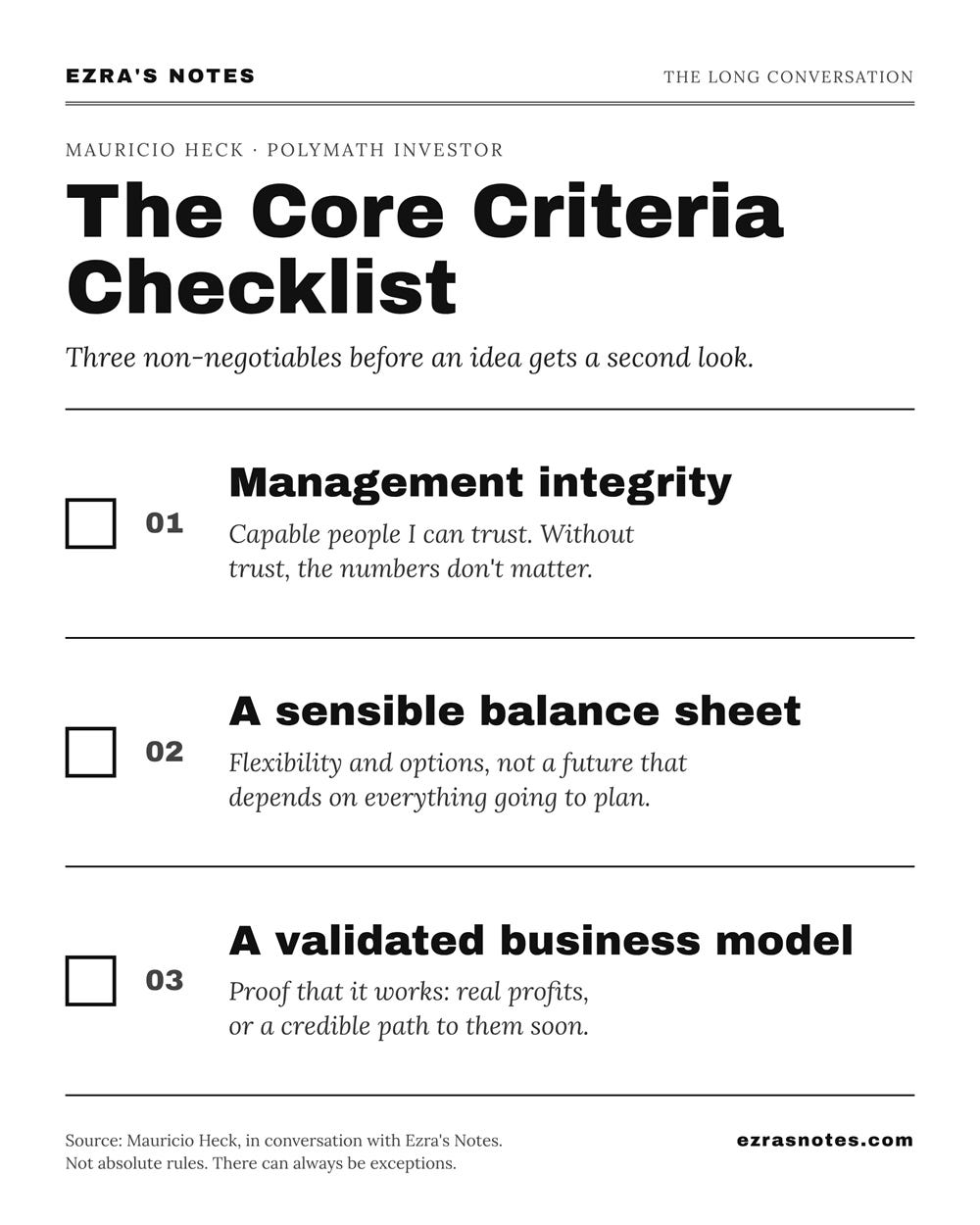
Share your core criteria checklist: the handful of non-negotiables every investment idea has to pass before you’ll consider it.
My checklist has evolved over time, and I expect it will continue to evolve.
I’ve never believed that investing can be reduced to a rigid formula where every company has to tick exactly the same boxes. Ultimately, you’re weighing the strengths and weaknesses of each particular opportunity.
But there are a few things I care deeply about.
First, management integrity. As they say, you can’t make a good deal with a bad person. That’s largely true. I want to invest alongside capable, high-integrity people. If I don’t trust management, it’s very difficult for me to justify owning the business, regardless of how attractive the numbers look.
Second, a sensible balance sheet. I generally avoid companies with excessive debt. I prefer businesses that have financial flexibility and optionality, rather than ones whose future depends on everything going according to plan.
Third, a validated business model. I’m generally not interested in companies that are still little more than a project or an idea. That includes most pre-revenue startups and junior mining exploration companies. I want to see evidence that the business model works, ideally through actual profitability or at least a credible path to generating profits in the near future.
Those aren’t absolute rules. There can always be exceptions.
But they’re the characteristics I tend to prioritize, and they help me eliminate a large number of opportunities fairly quickly.
If you could leave one piece of advice for other investors reading this — something you wish someone had told you earlier — what would it be?
I think this is similar to the question about books.
I’m not sure there’s such a thing as universal advice.
People are at different stages of their journeys, and what someone needs to hear at one point in life might be completely irrelevant at another.
I remember hearing a phrase in an interview or podcast that stuck with me. It was something along the lines of: “Everyone is at a different stage of their journey, so just be kind.”
I think there’s a lot of wisdom in that.
These days, particularly on X and other social media platforms, we’re constantly bombarded with advice.
Do this. Don’t do that. Follow these five steps. Adopt these seven habits.
Everything gets reduced to a recipe.
And I understand why. That’s partly a consequence of the incentives built into these platforms. The algorithm rewards simple, definitive statements. I’ve probably been guilty of that myself.
But life, and investing in particular, is much more complicated than that.
We’re all coming from different places, with different experiences, capabilities, and circumstances.
What works beautifully for one investor might be completely wrong for another.
If I had to offer one piece of advice, it would simply be: Know yourself.
Understand your strengths and weaknesses. Understand what kind of investor you are, what you’re good at, and what you should probably avoid.
And then be patient.
Take one step at a time. Learn one thing at a time. Keep improving.
A journey of a thousand miles begins with a single step.
That’s a useful way to approach investing.
You don’t have to figure everything out today. In fact, you can’t.
But if you keep learning, keep refining your thinking, and keep taking those steps, one day you’ll look back and realize just how far you’ve come.
And that’s really the beauty of this craft. There’s always something new to learn, and there’s never really a finish line.
Download this interview

Mauricio’s Core Criteria Checklist